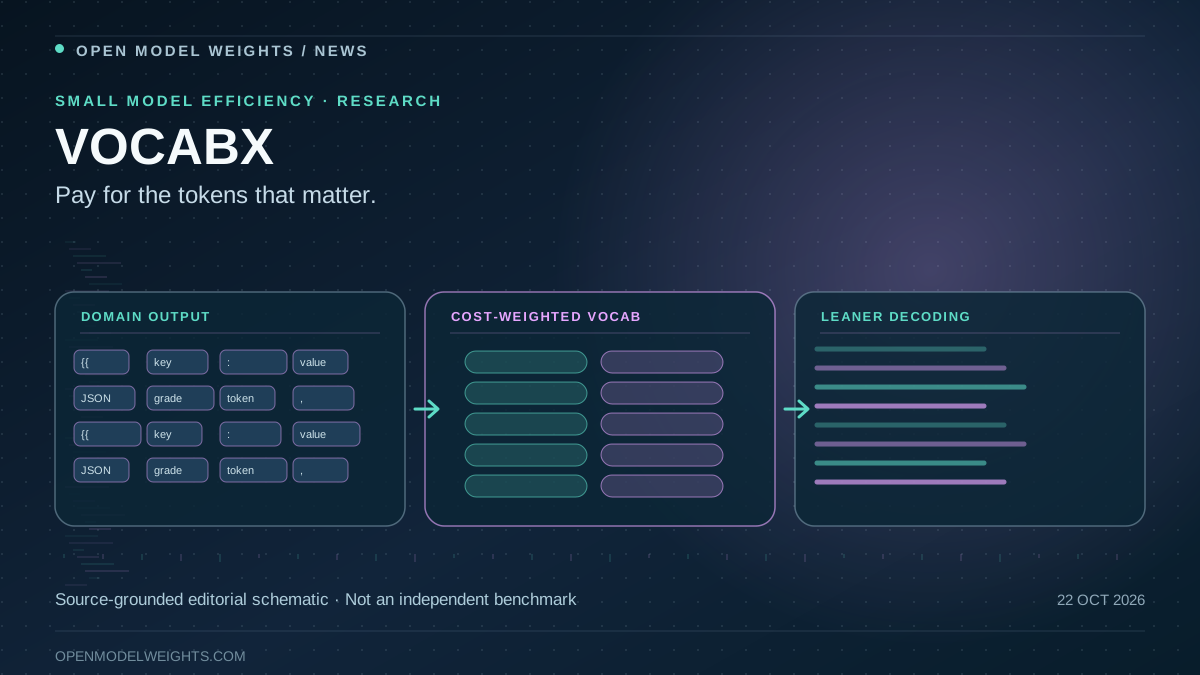
A new October 21 technical report from Dharma-AI argues that the tokenizer of an open-weight small language model can be an important inference-cost lever. The team's VocabX method adapts a model's output vocabulary for one domain, rather than assuming the general-purpose tokenizer inherited from pretraining is optimal. Its showcase is a Portuguese essay-grading service built on Qwen3-4B that repeatedly emits structured JSON. The headline result is a publisher-measured 77.0% lower inference cost on that particular task, not a universal speedup for Qwen-based deployments.
The approach attacks two sources of waste. First, recurrent phrases and complete structured response patterns are compressed into fewer output tokens through specialized subword and multiword units. Second, vocabulary pruning shrinks the output projection: an application that generates only a narrow range of text no longer needs to score so many irrelevant token candidates at each decoding step. The researchers also weight token savings by their estimated runtime costs, because an output token can be much more expensive than an input token in their setup.
In Dharma-AI's reported evaluation, a response fell from 350 tokens on average to 101, while its output vocabulary dropped from approximately 152,000 to 65,000 rows. Seven grader variants shared the base model, training data, recipe and seed; the authors replayed 500 requests using an RTX 5090 and vLLM. They report that preserving the separate grade decision token helped accuracy, whereas over-compressing decision-bearing JSON into a macro token hurt quality. This is useful nuance: maximizing compression is not equivalent to preserving the correct answer.
For teams operating specialized open weights, VocabX offers a research direction to investigate, not a ready-made cost guarantee or newly verified download. Replication needs the full upcoming paper, implementation details and domain-specific error analysis. Check end-to-end latency, calibration, output validity and quality under the real service distribution before inferring savings. The result is most relevant to repetitive, structured generation, not general-purpose chat or arbitrary multimodal inference.
What this changes for the evidence layer
Research/news only: no new general-purpose model weights or independently reproducible benchmark were established by this preview; retain existing Qwen3 model identities and do not add a phantom VocabX checkpoint.
Dharma-AI first-party VocabX vocabulary-specialization research preview
This brief is based on the cited primary source. Performance, benchmark and comparative claims remain attributed unless Open Model Weights publishes an independent measurement.
Open source article ↗