Hugging Face has published a practical curriculum for post-training tool-using AI agents. Its significance for open-weight teams is the sequence of reproducible training choices rather than a newly announced foundation model. The guide traces how a pretrained checkpoint can progress from imitating agent demonstrations to learning through multi-step interactions with a sandboxed environment. It combines technical material, documentation and example projects built around a coding-agent workflow, making the differences between training signals more explicit.
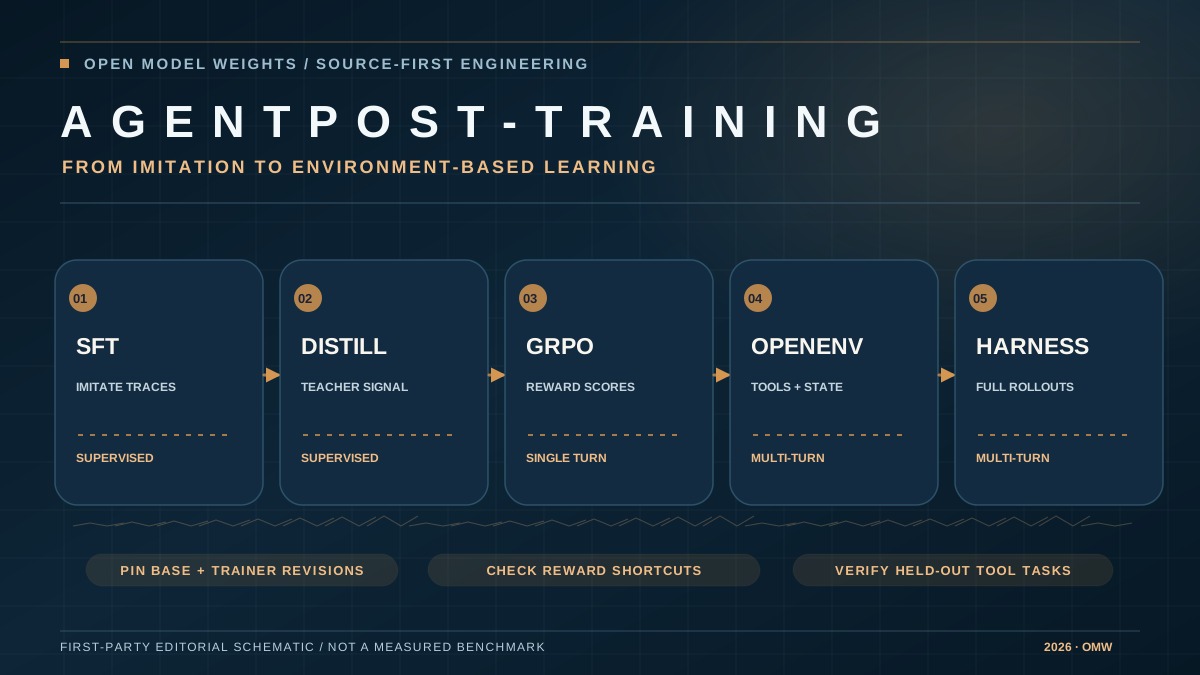
The first stage uses supervised fine-tuning with SFTTrainer and recorded agent traces. That gives a relatively stable way to teach tool-call formatting and common successful workflows, but the model has seen demonstrations rather than the consequences of its own mistakes. Distillation introduces a teacher that can supervise generated tokens or probabilities; on-policy versions can be more adaptive, although they require the teacher to run during training. Both approaches depend heavily on the quality and coverage of demonstrations or teacher responses.
The roadmap then switches to reinforcement learning. GRPOTrainer samples several candidate answers and scores them with a reward function, while a later OpenEnv stage runs agents across multiple stateful tool interactions and scores their outcomes. In a coding task, such an environment might execute a test suite rather than awarding points for plausible-looking code. Hugging Face finishes with AsyncGRPOTrainer applied to complete agent runs through an existing harness in remote sandboxes, separating generation resources from training so long rollouts do not leave accelerators idle.
These are not interchangeable recipes or proof that any particular model becomes an excellent agent. Reward design can encourage shortcuts, test results may not measure user intent, and untrusted tool outputs must be handled as an attack surface. A robust experiment should pin the base weights and trainer revisions, keep independent held-out tasks, inspect tool traces and recovery behavior, and track wall-clock compute plus successful task completion. The release supplies an open learning path; teams still need their own safety, licensing and evaluation controls.
What this changes for the evidence layer
This is an open-agent-training engineering guide, not a new downloadable foundation-model checkpoint. Keep it separate from model-registry intake and vendor capability rankings.
Hugging Face engineering guide on post-training agents
This brief is based on the cited primary source. Performance, benchmark and comparative claims remain attributed unless Open Model Weights publishes an independent measurement.
Open source article ↗