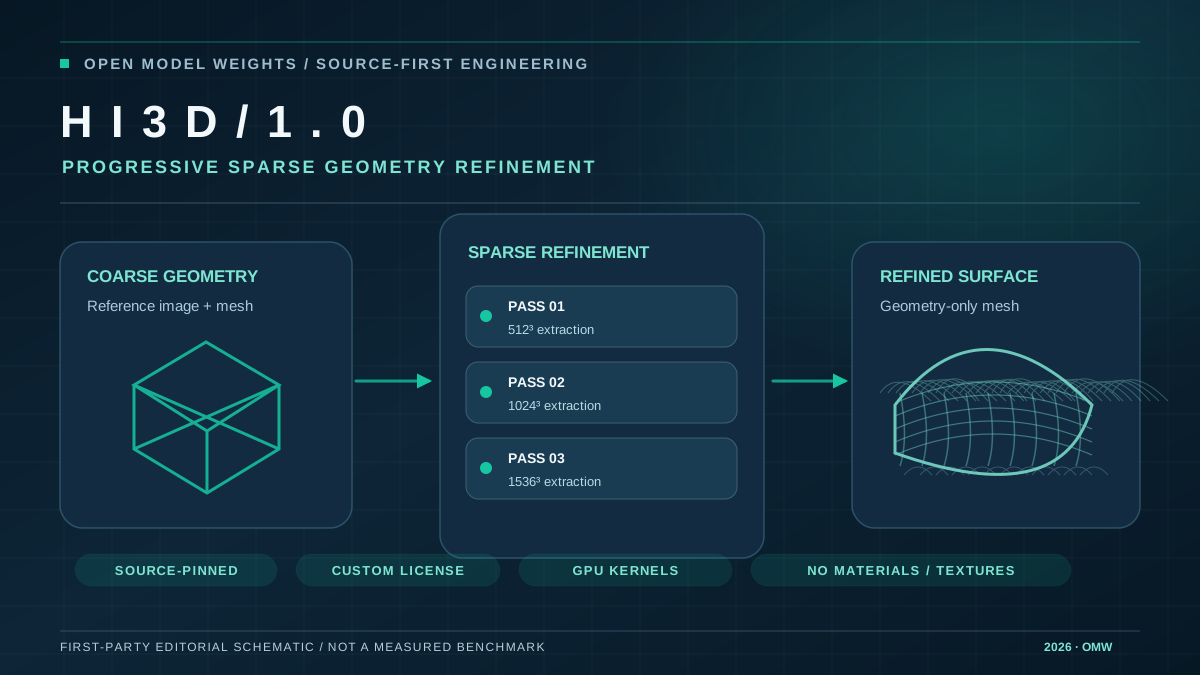
Hi3D has published the v1.0 weights and inference implementation for high-resolution three-dimensional geometry refinement. Rather than producing a finished 3D scene from a prompt, the Sparc3D-derived system takes a coarse mesh and a reference image of the same object, then iteratively refines geometric detail. The October 23 official release provides a model repository and code, allowing developers to inspect the pipeline instead of relying solely on a hosted demonstration. It does not release the full training recipe or the paper's evaluation harness.
The architecture uses progressive sparse processing. A first pass works with nominal 64³ structure and a 512³ extraction grid; subsequent passes move to 128³ and 1024³, then 192³ and 1536³. The repository names two transformer modules, a VAE and a scheduler among eight essential runtime files. These resolution numbers describe sparse coordinate and extraction stages, not an impossibly large dense 1536³ in-memory tensor. The high-resolution transformer is loaded only when the requested mode requires it, while the reference-image encoders come from separately distributed DINOv2 and CLIP models.
Hi3D's authors describe training on approximately two million curated 3D assets and showcase detailed reconstructed surfaces. These are publisher statements, not independent Open Model Weights measurements. The release notes also document important limits: geometry is produced without materials or texture, the result is normalized rather than preserving real-world scale, coarse-model structural errors can survive refinement, and GPU attention kernels lack a fallback path. Seeds alone do not guarantee bit-for-bit identical meshes across devices.
Commercial users must read the actual Hi3D Open License Agreement 1.0 instead of assuming that the mention of earlier Apache or MIT components makes the entire release Apache-licensed. The agreement describes branding and scale-related obligations; external coarse-mesh generators also require their own licenses. For a practical evaluation, pin the weight revision, run identical coarse meshes and reference images across all three stages, inspect topology and failure cases, and measure peak GPU memory separately from on-disk weight size.
What this changes for the evidence layer
Hi3D v1.0 is news, not an automatically field-verified canonical model. Check checkpoint SHA, exact Safetensors files, custom license, third-party encoders and GPU requirements before considering an intake.
Hi3D official 23 October weight-and-code release
This brief is based on the cited primary source. Performance, benchmark and comparative claims remain attributed unless Open Model Weights publishes an independent measurement.
Open source article ↗