The vLLM project published version 0.32.0 on October 18, bringing a substantial release for teams serving downloadable AI weights through their own infrastructure. Its official notes cover 814 commits from 363 contributors, but the practical story is not the commit count: it is a combination of new model interfaces, lower-precision memory options and security-related changes that can affect production upgrades. These are shipping features documented by the maintainers, not independent throughput results from Open Model Weights.
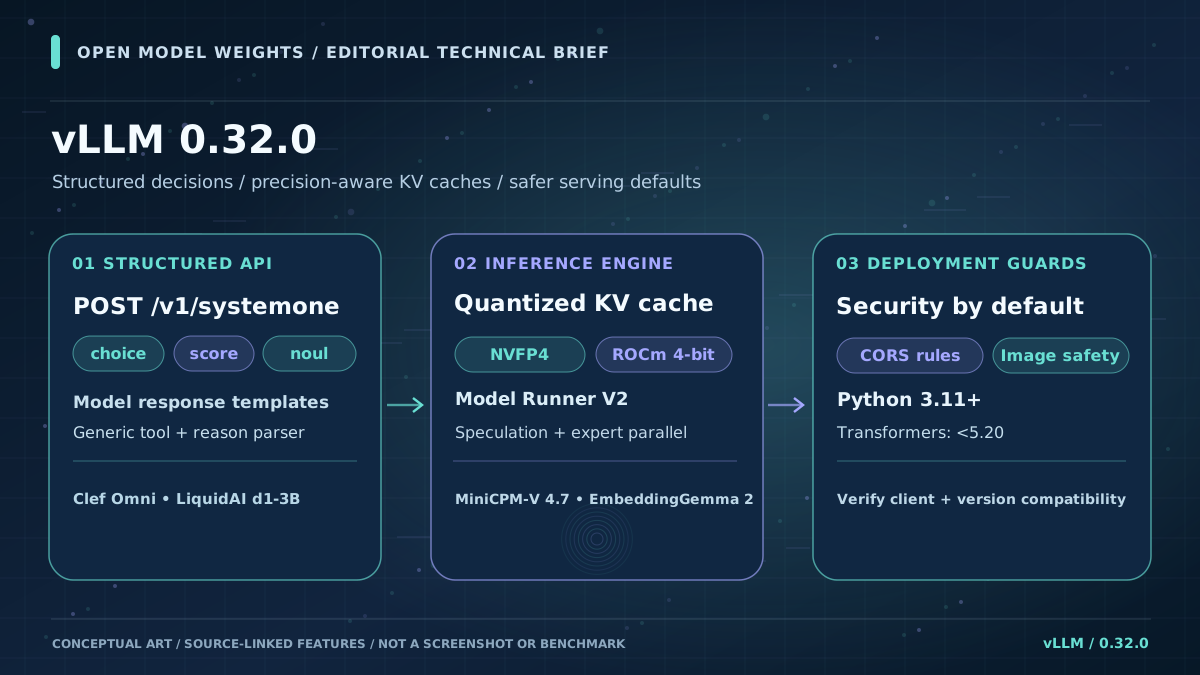
A new POST /v1/systemone endpoint accepts structured decision tasks such as choice, noul and score. The accompanying generic Hugging Face tool and reasoning parsers can read a checkpoint's response_template instead of requiring a custom parser for each supported model. The release lists Cloudflare Clef Omni, LiquidAI d1-3B and DiffusionGemma in the decision-serving work. Operators should check model-specific output semantics before treating the endpoint as a drop-in replacement for conversational generation.
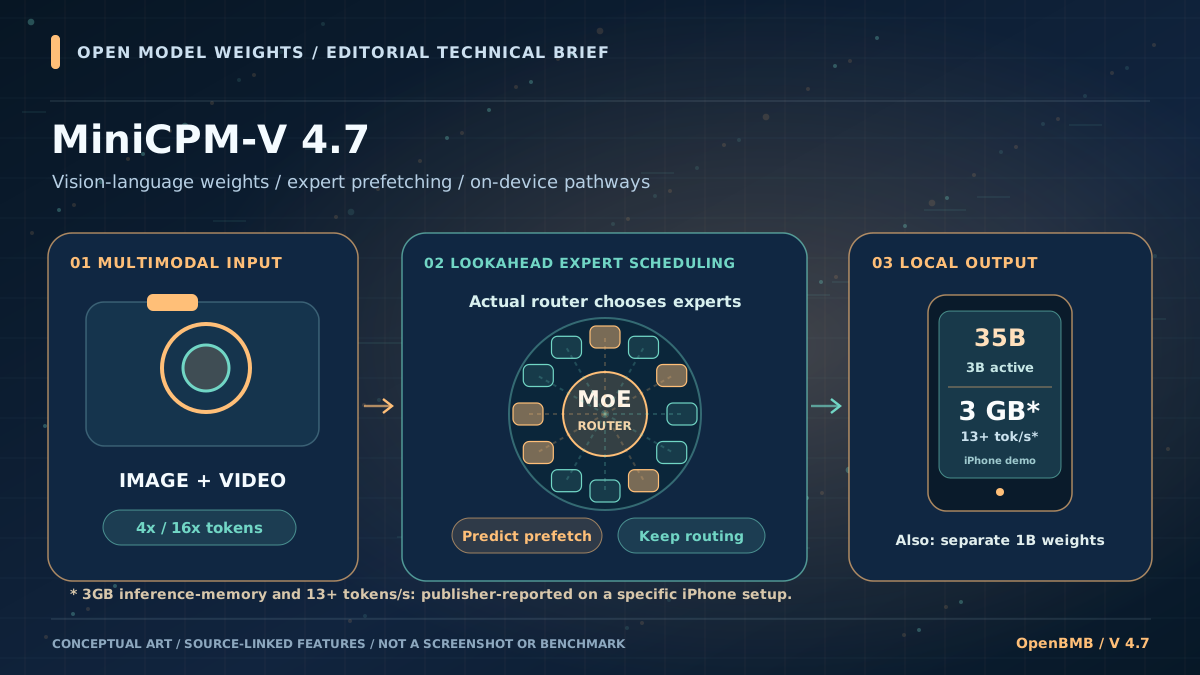
On the inference side, vLLM extends NVFP4 key-value caching to additional NVIDIA compute generations and adds a four-bit ultraquant_4bit KV cache on ROCm. Model Runner V2 gains speculative decoding and expert-parallel improvements. Project pull requests report gains for particular GLM and multi-worker configurations; those percentages depend on GPU, input length, concurrency and settings. Model integrations now include EmbeddingGemma 2 for cross-modal embeddings, MiniCPM-V 4.7 for vision tasks, and Nemotron 3.5 ASR for complete-audio transcription. Realtime streaming for that ASR backend is not yet supported.
Security and compatibility warrant equal attention. The release tightens default cross-origin access, rejects unsafe image formats, signs shared-memory cache handles, and addresses reported chat-template, tokenizer and peer-socket exhaustion risks. It also drops Python 3.10, requires Python 3.11 or newer, and pins Transformers to at least 5.16.1 but below 5.20.0. Browser-based clients that relied on permissive CORS must explicitly configure allowed origins. Several deprecated flags, parser events and context-window behaviors have changed.
The safest migration is to lock the exact v0.32.0 artifact, test the desired checkpoint and accelerator in staging, validate browser CORS and streaming responses, and compare your own latency and memory figures. Expanded runtime support alone does not verify a model's published license, weights or quality.
What this changes for the evidence layer
This is a serving-engine release, not source verification of any new model checkpoint. Independently pin the vLLM version and test hardware-specific KV-cache support, schema parsing, CORS, Python and Transformers dependency compatibility. Separately review exact model weight files, licenses and revisions before promoting EmbeddingGemma 2, MiniCPM-V 4.7 or other newly supported families into the canonical model registry. Release-note throughput figures are project/PR measurements, not our benchmarks.
vLLM project official v0.32.0 release notes
This brief is based on the cited primary source. Performance, benchmark and comparative claims remain attributed unless Open Model Weights publishes an independent measurement.
Open source article ↗