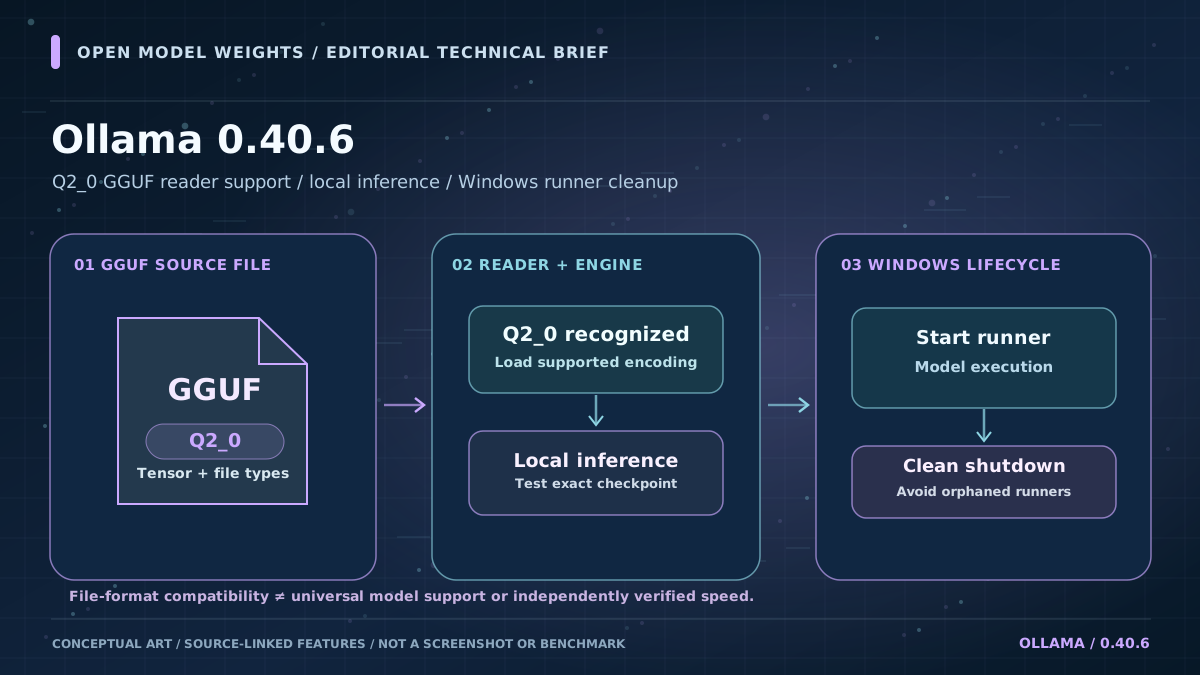
Ollama published its stable v0.40.6 release in mid-October with a change that matters to people running downloadable AI models locally: support for GGUF q2_0 tensor and file types. Its short official changelog also includes a Windows runner cleanup fix, a Cloudflare Clef cloud integration and a change to question identifiers in the --ask flow. The release is primarily a runtime and format update, rather than a newly trained language model or a broad performance announcement.
GGUF packages model tensors and metadata for compatible local inference engines. The merged upstream pull request explains the concrete failure: llama.cpp could run Q2_0 files, but Ollama's GGUF reader did not recognize the new tensor and file enum values. As a result, model creation could fail with an unsupported-tensor size error. Its author reports testing Prism ML Bonsai 2 files in 2B, 4B, 9B and 27B sizes on Apple silicon, where the previous version failed. Those are developer compatibility checks, not independent benchmarks across GPUs. Teams must still verify the specific checkpoint's license and revision separately.
The Windows fix targets orphaned runner processes. For developers switching models repeatedly, leaked child processes can complicate device memory accounting, debugging and shutdown, so lifecycle correctness matters even when it does not create a visible new UI feature. The source release does not publish a quantified resource-saving benchmark; a reliable check is to compare active runner processes and model load/unload behavior in the actual Windows environment before and after upgrading.
Ollama also lists the launch of Clef in its cloud offering and updates --ask question keys to use identifiers. Those additions should not be confused with local model-weight availability: cloud access may have separate operational terms and does not validate a downloadable checkpoint. Users automating interactive question flows should exercise their own CLI scripts after upgrading because identifiers can change how downstream integrations correlate prompts and answers.
For open-weight adopters, the right takeaway is careful compatibility testing. Pin Ollama v0.40.6, retain a known-good model artifact, inspect the actual GGUF encoding, and compare repeatable local correctness, memory and throughput results. Report upstream features as shipped, but leave unmeasured gains and model-license permissions explicitly unverified.
What this changes for the evidence layer
Ollama 0.40.6 is a runtime/format update, not proof that a particular Q2_0 model has newly appeared or is supported in every backend. Before linking any Q2_0 checkpoint, pin the upstream source file and SHA, inspect GGUF tensor types, original model license and CPU/GPU compatibility, then test outputs and performance locally. Do not infer model openness or independent benchmarks from the separate cloud feature.
Ollama project official v0.40.6 release notes and GGUF format pull request
This brief is based on the cited primary source. Performance, benchmark and comparative claims remain attributed unless Open Model Weights publishes an independent measurement.
Open source article ↗