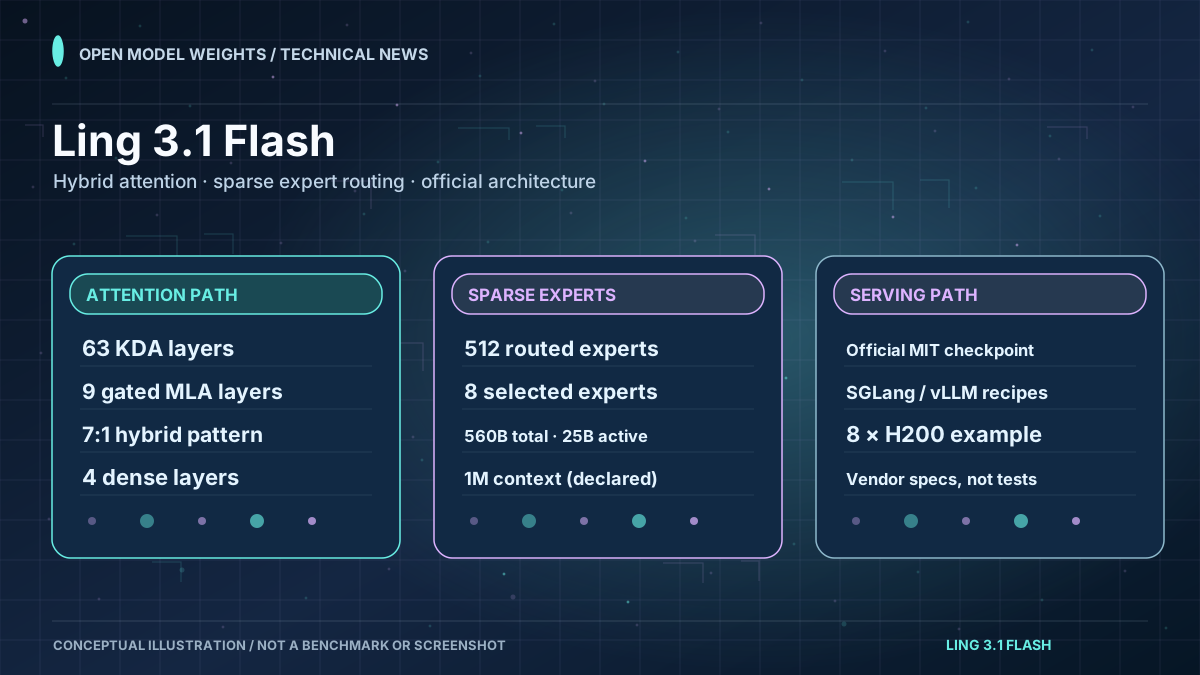
InclusionAI has published Ling-3.1-flash on its official Hugging Face account, with model files uploaded on October 13 and documentation revisions following on October 14–15. The model card positions this checkpoint as a hybrid reasoning model for coding, search, office workflows and long-running agents. Its headline specification is 560 billion total model parameters with 25 billion activated per token and a declared one-million-token context window. These are publisher specifications, not claims that the model will run on a consumer GPU or that every application can use the full window reliably.
The architecture is more specific than the usual sparse-MoE label. InclusionAI reports 63 KDA layers and nine gated MLA layers arranged in a 7:1 pattern, alongside four dense layers, 512 routed experts and eight activated routed experts. This combination is intended to trade attention and expert computation against the cost of serving very long sequences. Hugging Face also displays a 572B Safetensors parameter inventory; that repository-side count should not be silently substituted for the publisher's 560B logical model figure.
For deployment, the official card recommends a purpose-built SGLang image with an eight-H200 tensor/expert-parallel recipe, NEXTN speculative decoding and optional Hopper optimizations. The separate vLLM instructions require particular parser, cache and expert-parallel settings. These recipes are useful starting points for infrastructure teams but do not establish measured performance on other GPUs. Custom model code deserves the normal code-review and execution-security precautions.
The model card lists MIT licensing and names publisher-run evaluations on coding, terminal tasks, office work and healthcare. Its LingCode agent harness is described as a related system, not evidence that the downloadable model alone reproduces every agent benchmark; the publisher says it may open-source that harness later. Open Model Weights has not independently rerun the reported results.
The practical question is whether a team has the multi-GPU capacity, serving-stack compatibility and long-context evaluation to benefit from the checkpoint. For now, the strongest verifiable news is availability of an official, inspectable MIT-licensed weight release with an unusually detailed hybrid attention and expert-routing description.
What this changes for the evidence layer
Treat Ling 3.1 Flash as a distinct official checkpoint candidate, not automatically verified or promoted. Pin the upstream revision, inspect actual Safetensors and configuration, reconcile publisher logical 560B parameters with repository tensor counts, verify MIT license files and custom-code requirements, and review deployment on the stated multi-GPU hardware before registry inclusion.
InclusionAI official Ling-3.1-flash Hugging Face model card and revision history
This brief is based on the cited primary source. Performance, benchmark and comparative claims remain attributed unless Open Model Weights publishes an independent measurement.
Open source article ↗