OpenBMB announced MiniCPM-V 4.7 on October 12 and released downloadable vision-language checkpoints for local image and video understanding. The family spans a 35B-A3B mixture-of-experts model and a much smaller 1B variant. The official 35B-A3B model card lists Apache-2.0, and the project documents inference workflows for Transformers, vLLM, SGLang, llama.cpp and Ollama. The release matters because it connects substantial multimodal capability with resource-constrained, private-device deployment rather than an API-only product.
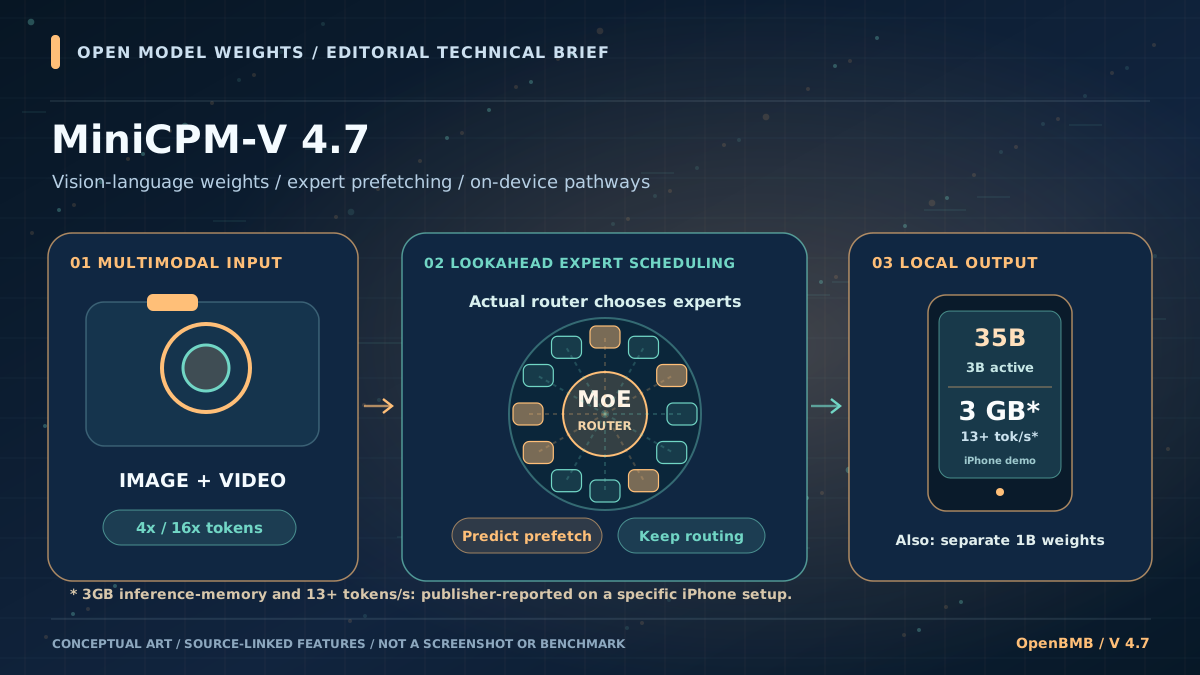
The 35B-A3B designation separates total parameters from the roughly three billion active along a token's MoE path. It does not mean that all weights occupy the memory of a 3B dense model. To keep expert loading practical on devices, OpenBMB introduces Lookahead Expert Scheduling: routing predictions prefetch likely experts across layers, while the real router still chooses the experts used for computation. Fine-grained quantization reduces transfers, and optional DSpark draft models add speculative sampling. Those parts interact; a headline memory number cannot be assumed for an ordinary unoptimized deployment.
OpenBMB reports more than 13 decoded tokens per second with about 3 GB of inference working memory on an iPhone 17 Pro Max. The figure is a publisher demonstration tied to its device and optimization stack, not evidence that the entire 35B checkpoint fits into 3 GB of storage or that every phone will reach the same speed. The project provides separate BF16, FP8, INT4, AWQ, GPTQ and GGUF routes for the larger model; quantization has fidelity and compatibility trade-offs that require application-level testing.
Multimodal handling is also configurable. The vision encoder offers 4x or 16x visual-token downsampling, a quality-versus-compute choice that can matter for fine text, OCR, dense documents and video. Example workflows cover single and multiple images, video understanding, PDF extraction and visual grounding. A 1B checkpoint offers a different deployment envelope; it should be assessed independently from the MoE's benchmark and memory claims. OpenBMB also publishes distinct DSpark draft weights for both sizes.
Developers should start with the precise publisher checkpoint, read the license, choose the image-processing and quantization path, and test their own documents and device constraints. Open-weight availability does not automatically validate benchmark rankings or establish identical behavior across all serving frameworks.
What this changes for the evidence layer
Treat 35B-A3B and 1B, each quantized checkpoint and every separate DSpark drafter as distinct candidate artifacts. Pin official Hugging Face revisions, inspect actual safetensors/GGUF files and the complete Apache-2.0 license, and verify processor and framework compatibility. The 35B total versus 3B active parameters must not be confused with an on-device working-memory claim; independently measure throughput and storage on the target hardware before ranking a model.
OpenBMB official MiniCPM-V 4.7 technical guide, changelog and model card
This brief is based on the cited primary source. Performance, benchmark and comparative claims remain attributed unless Open Model Weights publishes an independent measurement.
Open source article ↗