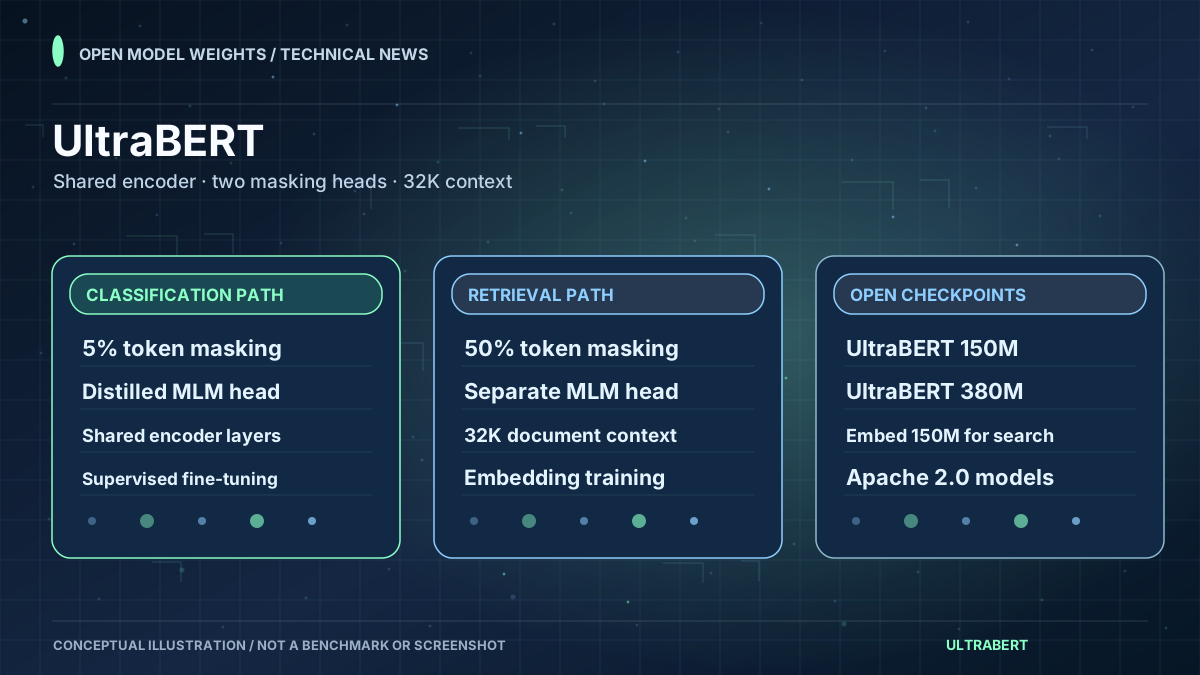
DMIS Lab's October 14 UltraBERT release puts three specialized open-weight encoders on Hugging Face: 150M and 380M pretrained backbones and a ready-to-use 150M embedding model. The team describes a native 32K-token context window and Apache-2.0 licensing. For production teams building retrieval-augmented generation, document classification or search, these compact models deserve attention precisely because they are not general-purpose text-generating chatbots.
The technical contribution addresses an old training conflict. The researchers found that low masking ratios favor classification, while heavier masking improved retrieval. Instead of settling on a single compromise, UltraBERT mixes examples masked at five and fifty percent in a shared encoder, with separate language-model heads and a different distillation treatment for each path. This is an architectural recipe aimed at producing a useful shared backbone across tasks, not an assertion that a single embedding representation wins every possible downstream test.
The authors report strong results after fine-tuning for classification and retrieval, including GLUE and BEIR comparisons across size-matched encoders. Their UltraBERT-Embed-150M model is a separate contrastively trained retrieval release, with a reported MTEB English v2 score of 67.24 and a 32K long-document workflow. They also report 99% on a passkey recall test across evaluated lengths up to 32K. These numbers are from the team's experimental setup and should not be represented as independent Open Model Weights verification.
Deployment paths are straightforward but task-specific. Hugging Face's article supplies Transformers masked-language-model and sequence-classification examples as well as a Sentence Transformers recipe for the embedding checkpoint. Retrieval queries use an instruction-style prefix; documents use their own encoding path. The model's 32K capability does not eliminate chunking, indexing, domain evaluation or latency planning for every search application.
The broader lesson is that an Apache-licensed, small encoder can be more suitable for repeatable high-volume retrieval and classification than asking an expensive generative model to perform every subtask. Users should choose the embedding release for immediate vector search, the backbones for supervised fine-tuning, and validate language coverage and retrieval quality against their own corpus.
What this changes for the evidence layer
The 150M and 380M backbones and the 150M embedding model require distinct source-verified registry entries if selected. Confirm upstream SHA, actual weights, configuration, Apache-2.0 license and advertised 32K input limit. Keep paper-author benchmark results distinct from our own measurements and do not classify masked-language-model encoders as conversational LLMs.
DMIS Lab original UltraBERT release article and model collection on Hugging Face
This brief is based on the cited primary source. Performance, benchmark and comparative claims remain attributed unless Open Model Weights publishes an independent measurement.
Open source article ↗