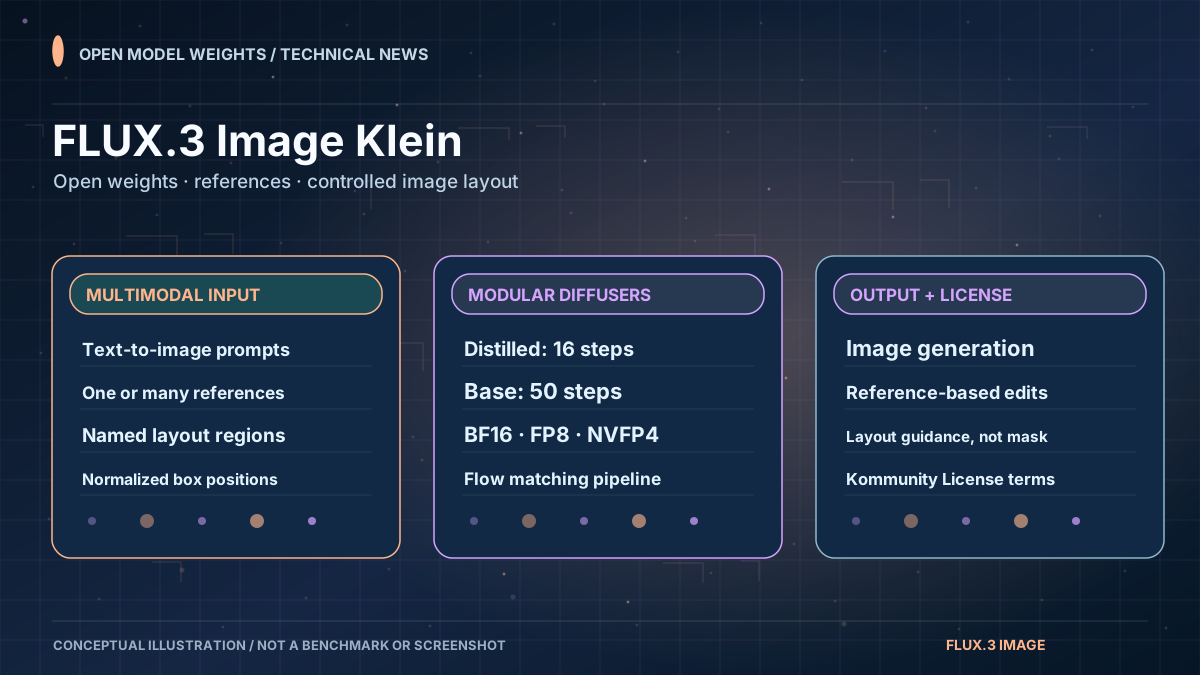
Black Forest Labs' FLUX.3 Image Klein family is now documented in a new Hugging Face Diffusers technical walkthrough published October 15. It provides two downloadable model tracks: the distilled FLUX.3 Image Klein checkpoint, which defaults to 16 generation steps without classifier-free guidance, and the base checkpoint, which uses a 50-step workflow and is intended for further training and LoRA work. This is a weight release with local inference instructions, not merely an API announcement.
The most useful new control is structured image layout. In addition to text-to-image and one-or-many reference-image editing, the pipeline accepts prompts with named regions and normalized bounding boxes. Developers can tell it roughly where an object belongs or how to move one between source and target positions. Those boxes are steering hints, however, not a hard segmentation mask: small objects may be omitted and editing can alter regions outside the requested box.
The implementation matters for practical adoption. Diffusers exposes modular pipeline blocks, supports pre-encoding a prompt once and reusing embeddings, and shows how to load BF16, row-wise FP8 and NVFP4 transformer files. Its authors report roughly two seconds for a 1024-pixel distilled text-to-image example on an H100, but that figure is tied to their exact test configuration. The model card gives different peak-memory numbers for the separate Black Forest Labs reference stack. Neither should be generalized to arbitrary cards, prompt upsamplers or batch sizes.
Licensing is a major caveat. The FLUX Kommunity License v1.0 primarily allows non-commercial model use, with a conditional exception for commercial output generation by qualifying users below a stated revenue threshold. It is not equivalent to Apache 2.0 or a general right to commercial fine-tuning, distribution or service operation. The separately included Qwen3-VL text encoder has its own Apache-2.0 status.
For developers, FLUX.3 Image Klein is notable for combining image synthesis, edit references and placement control under one openly downloadable model family. The sensible next step is to compare quality and memory on the intended workload, read the full license and distinguish the distilled fast-inference checkpoint from the base training-oriented variant.
What this changes for the evidence layer
Both distilled and base FLUX.3 Image Klein model repositories are separate candidate checkpoints. Source-check their actual weights and revision SHA, included text encoder/VAE, FP8/NVFP4 variants and the full FLUX Kommunity License before adding models or marking business use as permitted. Publisher end-to-end timings must not be recast as independent consumer-GPU performance.
Hugging Face Diffusers team technical announcement and Black Forest Labs official model card
This brief is based on the cited primary source. Performance, benchmark and comparative claims remain attributed unless Open Model Weights publishes an independent measurement.
Open source article ↗