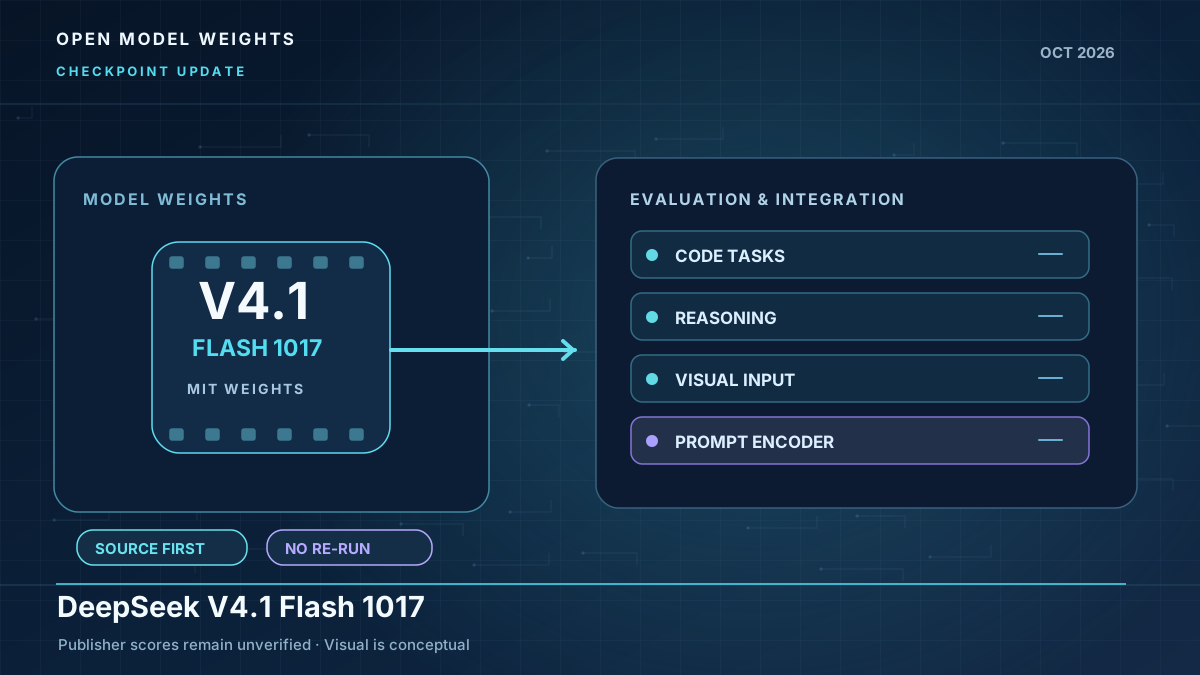
DeepSeek published a new DeepSeek-V4.1-Flash-1017 checkpoint on October 17, describing it as a minor update to V4.1 Flash rather than a new model family. The official Hugging Face page exposes Safetensors weights and identifies the license as MIT. For operators following fast-moving open-weight systems, the distinct model repository matters: deployment manifests and comparison reports should refer to the exact 1017 revision, not silently reuse assumptions about its predecessor.
DeepSeek says the update improves reasoning, coding, agent-oriented workflows and visual evaluations while reducing task duration and generated output. Its published scorecard lists Terminal-Bench 4.0 at 42.3 versus 31.2 for the prior Flash model, and ProgramBench at 29.1 versus 20.3. These numbers are publisher-reported comparisons using named harnesses; Open Model Weights has neither rerun them nor established cross-provider equivalence. Tool settings, benchmark versions and compute budgets can change the interpretation.
The release also brings an integration detail that is easy to miss: there is no Jinja chat template in the repository. Instead, DeepSeek includes a Python prompt-encoding reference, test cases for tool calls and mixed image content, and a maintained Rust-based deepseek-recipe library with Python bindings. The toolkit handles prompt and response formatting, not the inference server or tool execution. Serving stacks must keep those concerns separate to avoid misleading performance or compatibility claims.
DeepSeek's model card recommends a one-million-token context setting and links to local weight-conversion instructions. That configuration should not be read as a guarantee that any particular GPU can process the maximum window efficiently. Teams should verify artifact access, memory planning, exact MIT license text, multimodal preprocessing and end-to-end output parsing before migrating a production agent from the previous checkpoint.
What this changes for the evidence layer
The official deepseek-ai/DeepSeek-V4.1-Flash-1017 checkpoint is a separate publisher artifact from earlier DeepSeek V4.1 versions. Its model card advertises MIT terms, multimodal input and deployment instructions; none of these makes it an independently verified Open Model Weights model record. Source-first intake must inspect the exact repository revision, manifest, license file and serving-specific prompt encoder before adding or revising registry capabilities.
DeepSeek official V4.1 Flash 1017 model card and MIT license
This brief is based on the cited primary source. Performance, benchmark and comparative claims remain attributed unless Open Model Weights publishes an independent measurement.
Open source article ↗