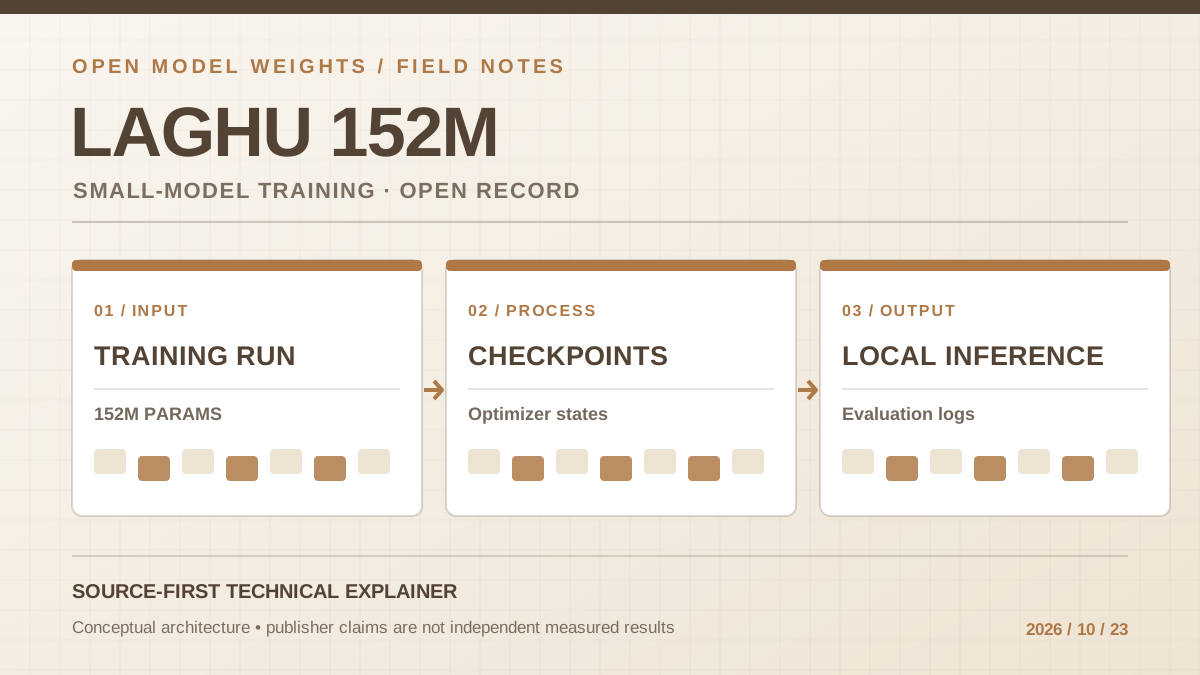
Udgam Labs has announced Laghu, a 152-million-parameter chat model positioned as a deliberately small and inspectable experiment in training from scratch. The project's official Hugging Face announcement puts pretraining compute expenditure at approximately $146 and describes a 163 MB build capable of running in a browser or via local runtimes. Those numbers are reported by the creators for their specific setup; they do not include every potential cost of data preparation, engineering, evaluation, hardware access or real-world inference.
The distinctive part of Laghu is provenance. The team says it is releasing training code, intermediate surviving checkpoints, optimizer states, per-item evaluations and records of unsuccessful runs, rather than publishing only one finished weight file and a broad performance claim. That makes the project relevant to students and engineers trying to understand the whole lifecycle of a tiny language model. A 16K context claim and configurable thinking-on or thinking-off behavior also provide tractable experiments in constrained reasoning.
The authors compare the base model on contemporary held-out text and describe performance near SmolLM2-135M-Instruct on selected chat and multi-turn assessments, with different results on mathematics and Falcon-H1-Tiny-90M-Instruct comparisons. Such numbers should be interpreted only within the authors' prompt format, tokenizer and evaluation harness. They are not independent Open Model Weights measurements or evidence that a 152M model rivals current general-purpose frontier systems. Small models also require explicit safety and domain testing before public deployment.
Laghu offers a practical reproducibility case study: first verify the chosen model repository and license files, pin weights and tokenizer revisions, then reproduce a small set of baseline tasks before evaluating local latency and memory. Researchers should inspect the open training record to understand how text selection and failure analysis affected results. For organizations that value inspectable workflows more than broad capability, its real contribution may be the published process, not a leaderboard position.
What this changes for the evidence layer
A Laghu family checkpoint is not automatically a canonical verified model. Source-first weight, license and pinned revision checks are required before any separate intake.
Udgam Labs official Laghu training and model announcement
This brief is based on the cited primary source. Performance, benchmark and comparative claims remain attributed unless Open Model Weights publishes an independent measurement.
Open source article ↗