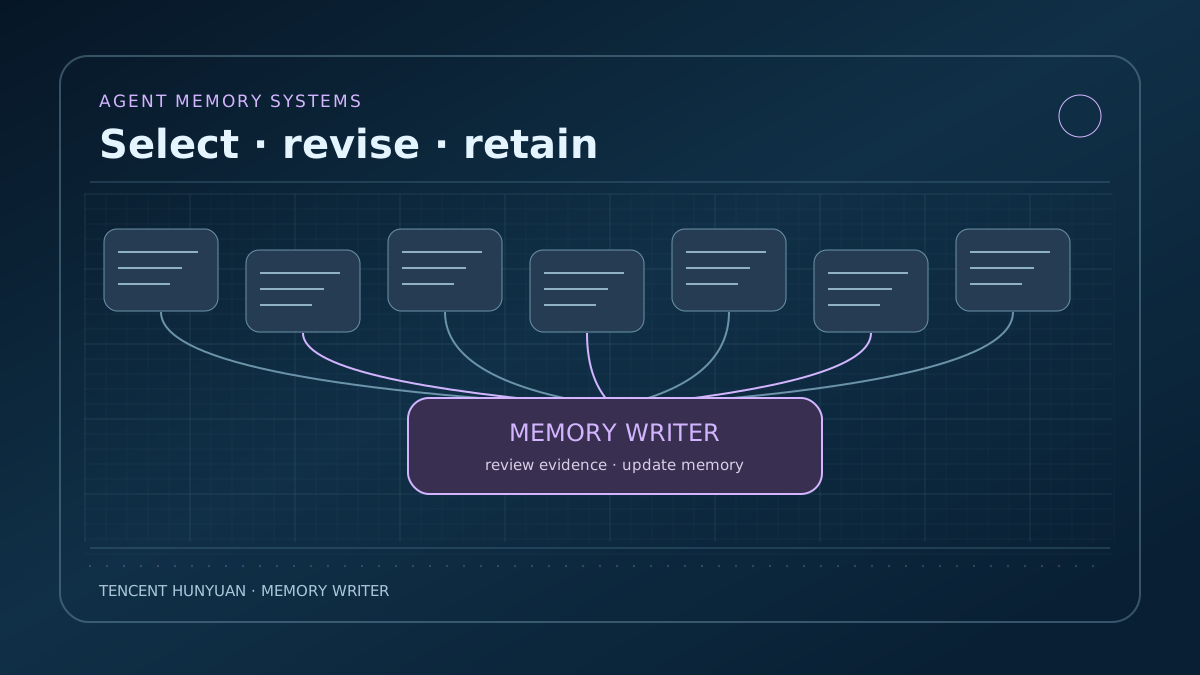
Tencent Hunyuan has released Hy-Memory-30B-A3B, a specialist model for the often-overlooked memory-writing task in AI agents. It has approximately 30 billion total parameters and activates around three billion per token. Unlike an ordinary language model or vector database, the system is meant to decide which pieces of conversation and work history should be saved, updated or discarded inside an external memory framework.
The publisher describes integrations with Mem0, MemOS and its own Hy-Memory system for chat, working and coding scenarios. Training combines Memory On-Policy Distillation with Attributed Memory Reinforcement Learning. The former supplies examples of high-quality memory-state changes; the latter reinforces decisions according to how useful the resulting memory bank proves across later interaction windows. This is an interesting shift from merely retrieving raw conversation snippets.
Tencent's research evaluates the writer inside four controlled memory-framework setups and across several task metrics. Retrieval configuration, the answering model and other components are held fixed while the writer changes. The main benchmark matrix nevertheless uses a fixed 20% subsample, and the numbers are produced by the publisher. The separately held-out EverMemOS harness tests transfer to an unseen framework, but independent real-world validation is still needed.
The model card lists Apache 2.0 and links runnable code, safetensors and a technical report. Hardware sizing must consider the full stored weight set and cache instead of treating three billion active parameters as the complete footprint. Our assessment: memory writing may become its own open-weight infrastructure layer, but deployments should test incorrect retention, outdated facts, access controls, deletion requests and confidential-information leakage before trusting persistent memories.
What this changes for the evidence layer
News is not independently verified model-registry evidence. Confirm the exact upstream file revisions, license, architecture and source conditions before any model promotion or derived speed and capability claim.
Tencent Hunyuan official Hy-Memory model card
This brief is based on the cited primary source. Performance, benchmark and comparative claims remain attributed unless Open Model Weights publishes an independent measurement.
Open source article ↗