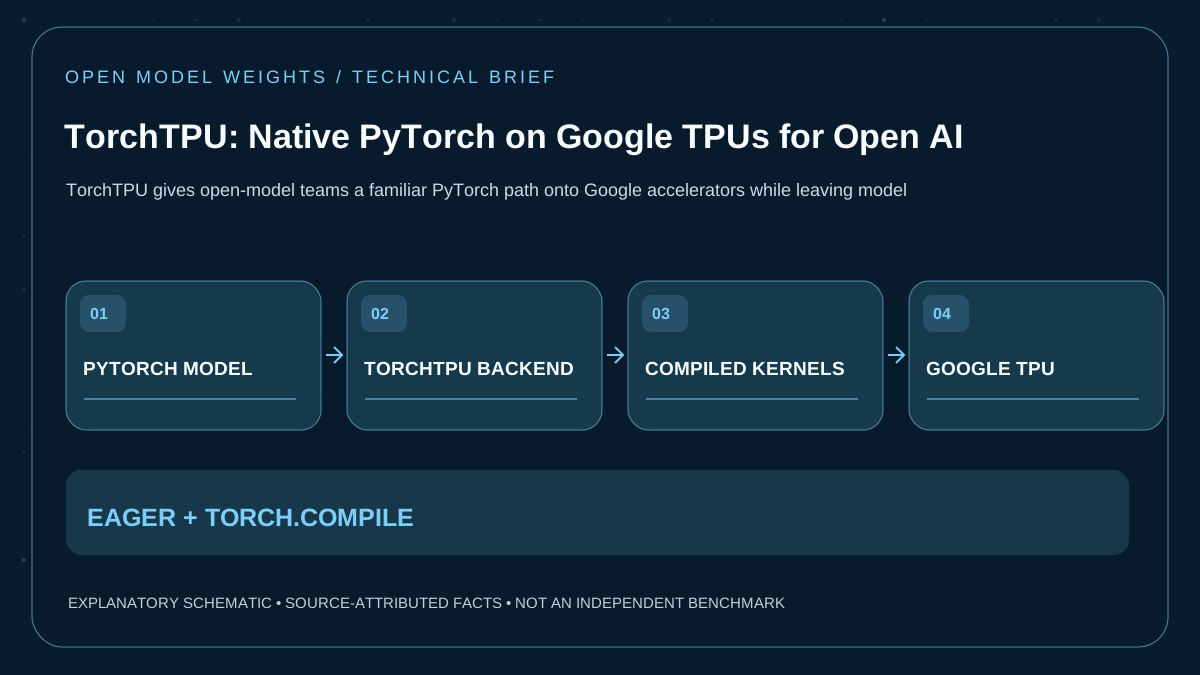
Google has open-sourced TorchTPU, an attempt to make its accelerator hardware a native PyTorch deployment target for open-weight AI. The October 20 launch was developed with partners including Meta and Hugging Face. A TPU backend that follows familiar PyTorch interfaces can reduce migration friction compared with PyTorch/XLA's older lazy-execution model or rewriting a project around JAX. TorchTPU itself is software, not a new downloadable language model.
Hugging Face illustrates the workflow using Transformers v5: a model can be loaded with device_map set to tpu, while Diffusers pipelines can move to the same device. The backend combines eager execution for debugging with torch.compile for optimized workloads. Google's release also refers to integration work across vLLM, SGLang, llm-d, Ray and TorchTitan. Those names describe a broad ecosystem effort, not proof that every model architecture or optimizer works unmodified.
The maturity evidence is unusually concrete. Hugging Face reports that 96.5 percent of Transformers tests runnable on TPU were passing, after identifying 34 upstream issues and fixing 19. The excluded tests, outstanding failures, compilation costs and precision restrictions still matter. Model placement across chips and tensor shapes also change cost and performance. The claimed simplification should be checked against actual kernels and distribution strategies before production adoption.
For operators, the larger implication is hardware optionality: teams may test the same open-weight checkpoint on TPU infrastructure instead of committing permanently to one vendor stack. But cloud pricing, utilization and latency cannot be inferred from the launch. Open Model Weights has run no independent TorchTPU cost or throughput evaluation. License permissions for an individual model remain separate from the open-source runtime.
What this changes for the evidence layer
TorchTPU is an accelerator software layer, not a checkpoint. Model source claims, supported versions and any benchmark measurements must remain individually attributed.
Google Cloud official TorchTPU announcement
This brief is based on the cited primary source. Performance, benchmark and comparative claims remain attributed unless Open Model Weights publishes an independent measurement.
Open source article ↗