NVIDIA introduced Cosmos3-H-Dreams on October 20, extending its action-conditioned video research from tabletop surgical demonstrations to clinical cholecystectomy scenes. The project addresses a practical problem for surgical robotics: a generative world model must respond to the movements of surgical tools, not merely produce realistic-looking clips. NVIDIA offers model checkpoints and research tooling for controlled simulation, not a verified clinical assistant.
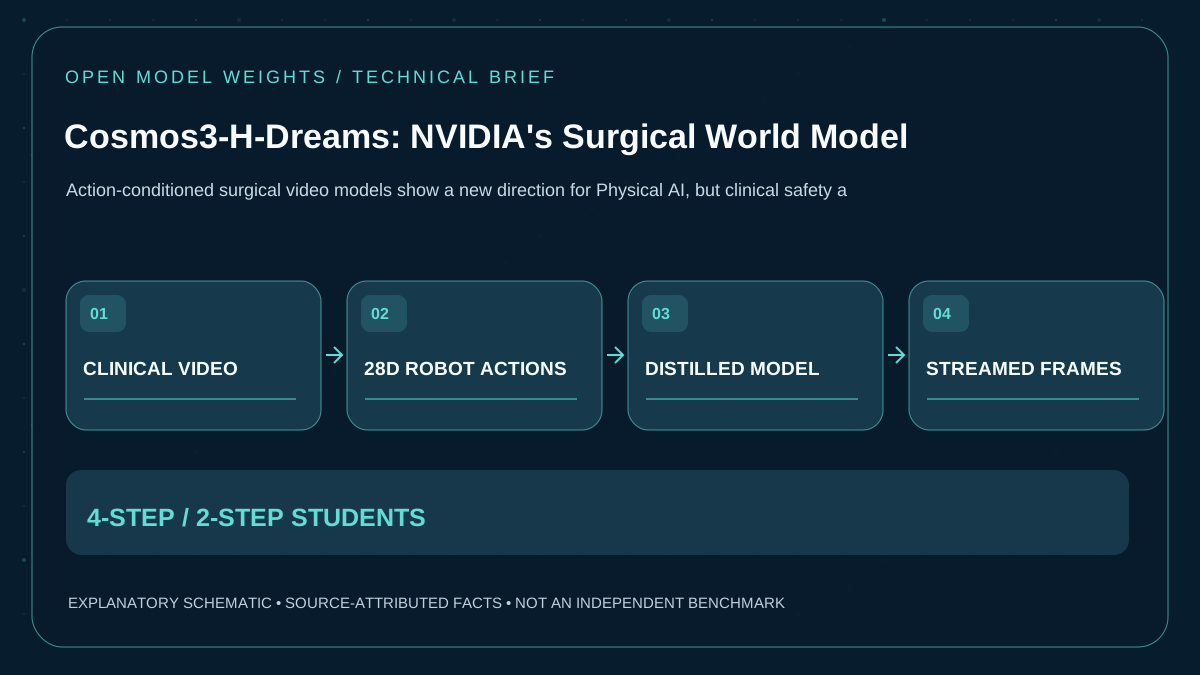
The system is built around the Cosmos3-H-Embodied-Nano foundation, which NVIDIA describes as a 16-billion-parameter model. The team trains on synchronized surgery recordings and robot kinematics captured using the Versius platform. Its published description includes 28 action dimensions covering two tools and controller signals, and 832-by-480 training video aligned with actions at 10 Hz. These specifications do not measure independent runtime speed.
NVIDIA describes a teacher-to-student pipeline. A bidirectional teacher learns from video sequences, followed by causal students trained for streaming prediction. Two released variants have four and two denoising steps respectively; the smaller step count represents a separately trained checkpoint and is not simply an arbitrary inference setting. FlashDreams and attention-cache consolidation address streaming behavior. NVIDIA reports distinct simulated continuations for different instrument actions, but does not establish universal physical accuracy.
Before using such a simulator, researchers should test instrument following, tissue consistency, temporal drift and rare failure modes on unseen procedures. The artifact-specific weight license and training-data terms must be inspected rather than inferred from older Cosmos releases. Open Model Weights has not evaluated these simulations. Our assessment: the advance matters for controllable Physical AI and synthetic training environments, but published demos are not evidence of medical safety or surgical performance.
What this changes for the evidence layer
New downloadable surgical world-model checkpoints require exact repository SHA, checkpoint-specific license, weight-file and control-format verification before canonical catalog inclusion.
NVIDIA official Cosmos3-H-Dreams announcement
This brief is based on the cited primary source. Performance, benchmark and comparative claims remain attributed unless Open Model Weights publishes an independent measurement.
Open source article ↗