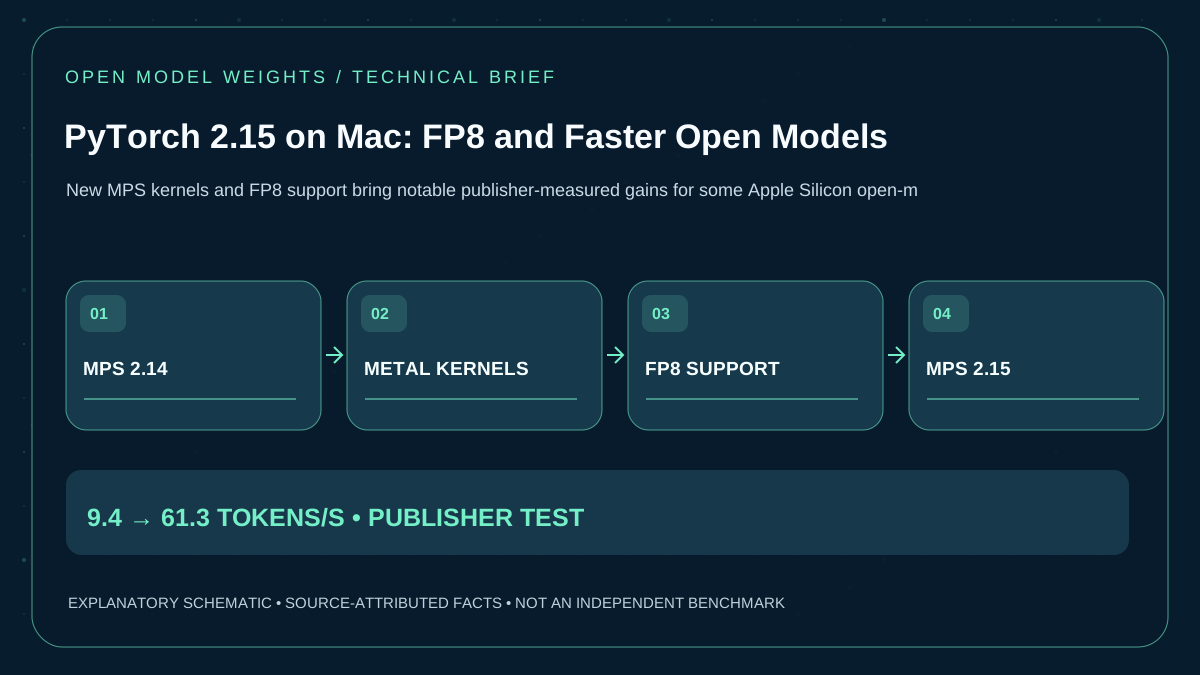
Apple Silicon users gain a substantive open-model runtime update with PyTorch 2.15. In an October 20 technical report, Hugging Face's PyTorch contributors document FP8 tensor support and new Metal kernels for decoding, padding, linear algebra and other operations. This is an improvement to the machine-learning runtime, not a change in any model's checkpoint, weights license or intrinsic benchmark capability.
The most striking reported example is Qwen3.6-35B-A3B on an M3 Ultra. In the contributors' compiled mixture-of-experts test, output decoding rises from 9.4 tokens per second on PyTorch 2.14 to 61.3 on 2.15. The report attributes the gain to grouped matrix multiplication, better expert routing and fewer CPU-GPU synchronizations. It is a configuration-specific developer measurement, not an independently verified speedup across all Apple computers or inference applications.
The authors also report that the peak driver memory for one Wan2.2 tiled video-VAE decode fell from approximately 270 GiB to about 8 GiB after changing constant-padding execution to Metal. Added FP8 e4m3 support can halve raw value storage compared with BF16, while scaled matrix multiplication makes those values useful for supported operations. Neither figure should be mistaken for guaranteed system-wide memory use, and quantization still has accuracy and compatibility tradeoffs.
Developers need to check exact release packaging, model shapes and host requirements. The current MPS backend requires macOS 15 or newer; PyTorch 2.15 requires Python 3.11 or newer. Previewed improvements planned for 2.16 are not shipped features of 2.15. Open Model Weights has not reproduced these tests. The opportunity is better practical access to local models, but each deployment still needs a reproducible measurement.
What this changes for the evidence layer
Do not turn vendor-reported runtime speedups into independent benchmark records or create model entries for a PyTorch backend release.
Hugging Face PyTorch MPS engineering report
This brief is based on the cited primary source. Performance, benchmark and comparative claims remain attributed unless Open Model Weights publishes an independent measurement.
Open source article ↗