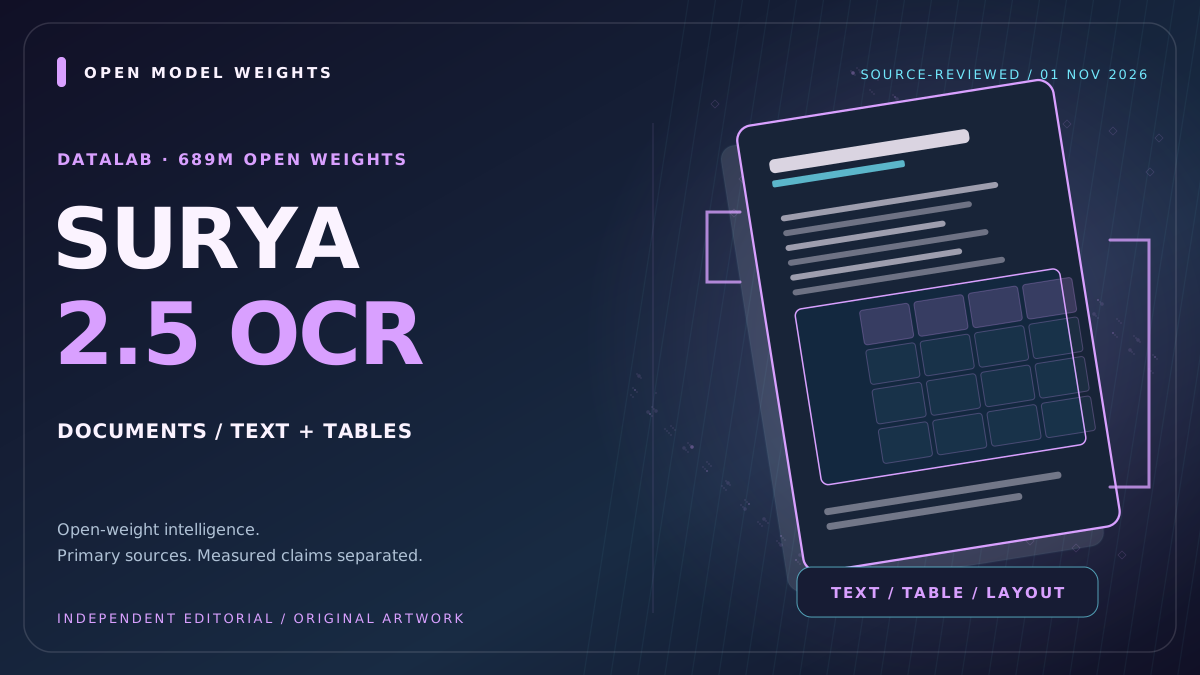
Datalab has released Surya 2.5, a 689-million-parameter open-weight OCR and document-structure model aimed at turning scanned pages into usable text, tables and layouts. It matters to local retrieval and agent systems because finding relevant evidence often starts long before an embedding model receives a text passage: documents first need correct reading order, table cell structure and faithful character transcription. Surya 2.5 is a new downloadable checkpoint, distinct from Baidu's Unlimited OCR 2 release that Open Model Weights has already covered.
The publisher reports an OmniParseBench headline score of 85.9, up from 83.3 for Surya 2, and a table score of 78.3 versus 74.3 in its comparison. The test suite contains thousands of pages across many languages and checks text, layout and tables. The model card also describes 91-language internal coverage and HTML output that can preserve table cell spans. These are valuable capabilities, but the stated advantage is limited to the publisher's documented harness and competing configurations, not a universal ranking across all PDF extraction workloads.
Efficiency is another important part of the release. Datalab reports processing about 4.5 pages per second on one H100 at 192 DPI with 32 concurrent requests, compared with approximately 2.7 for the earlier Surya 2 configuration using multi-token prediction. A larger 88,526-entry vocabulary is intended to encode pages in fewer output tokens, including emoji and styled mathematical letters that previously caused problems. Datalab also reports that looping until the output limit fell sharply. Actual end-to-end throughput will depend on resolution, page complexity, batching, backend and post-processing.
Licensing needs particular care. The project's inference code is distributed under Apache 2.0, but the model weights use a modified AI Pubs OpenRAIL-M license rather than unrestricted Apache terms. Datalab describes free use for research, personal projects and qualifying startups below a stated financial threshold, while broader commercial use requires additional licensing review. This difference should be visible before anyone deploys the OCR service inside a customer-facing workflow. Open Model Weights records Surya 2.5 as an important document-understanding release without presenting Datalab's benchmark results as independently reproduced or inventing blanket commercial permissions.
What this changes for the evidence layer
The original Datalab announcement, model card and code license are separately verifiable. This News is not a new field-verified registry admission. Preserve the distinction between Apache-licensed source code and modified OpenRAIL-M checkpoint weights, and verify the current license text for specific commercial deployment.
Datalab official Surya 2.5 engineering release
This brief is based on the cited primary source. Performance, benchmark and comparative claims remain attributed unless Open Model Weights publishes an independent measurement.
Open source article ↗