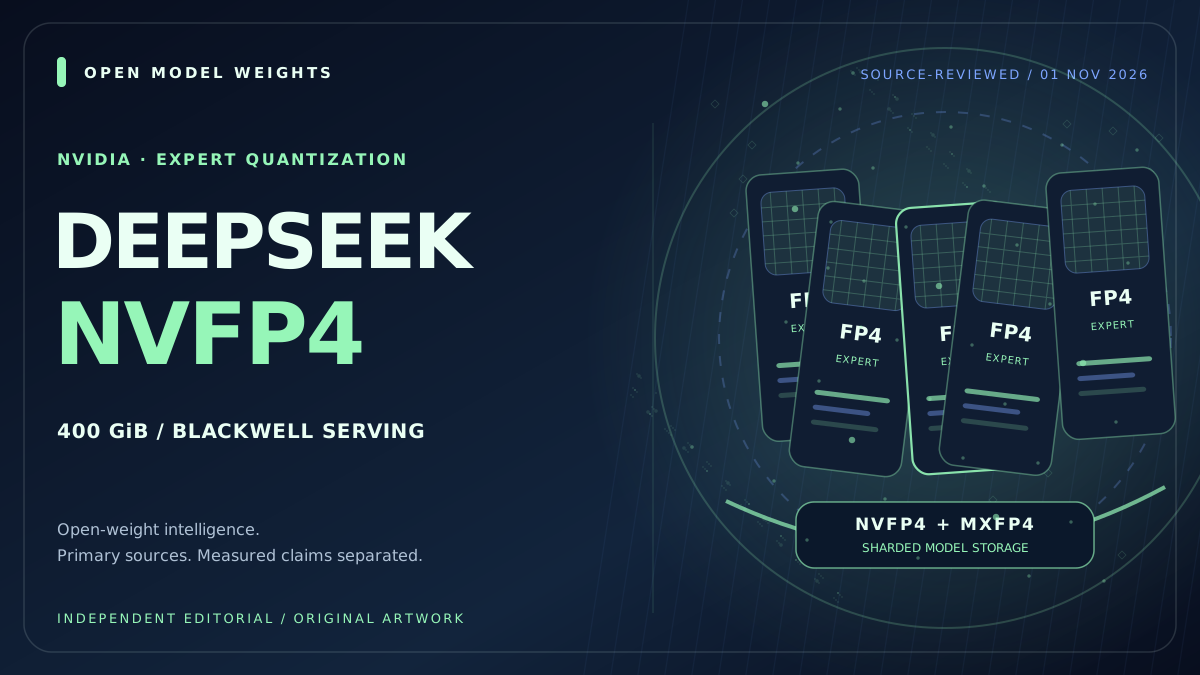
NVIDIA has published DeepSeek-V4.1-Flash-1017-NVFP4, a hardware-oriented quantized distribution of DeepSeek's previously released V4.1 Flash 1017 model. This is not a new reasoning architecture and it does not add a separately trained foundation model to the open-weight ecosystem. The practical news is a different representation of very large, already-public weights intended for NVIDIA Blackwell inference. That distinction is important when assessing a release: the download and serving requirements change even when the underlying source model does not.
The official NVIDIA model card reports a checkpoint of approximately 400 GiB, rather than about 475 GiB for the source package, spread across 48 Safetensors shards. It identifies a 552-billion-parameter backbone with separately described Engram conditional memory, and a multimodal text-and-image interface. Expert projections across the mixture-of-experts layers are represented using NVFP4 four-bit weight-and-activation quantization with group size 16. The Engram lookup tables are instead encoded as MXFP4. Other components, including attention, shared experts and vision, retain specified source precisions; this is not a uniform all-FP4 model.
The publisher says that conversion of the ordinary expert weight blocks preserved their dequantized values, while the Engram conversion is lossy. Activation scales also required calibration and a small number of fallback values. Those technical qualifications matter more than simply calling the checkpoint 'lossless.' NVIDIA publishes comparative evaluation figures for its own setup, but these do not establish identical outputs or independent quality and throughput. Open Model Weights has not reproduced the tests.
Deployment has a specific integration constraint: the model card states that the MXFP4 Engram tables require a vLLM build with additional Engram support, rather than an ordinary stock image. Its documented serving test uses four NVIDIA GB300 GPUs; SGLang was not validated for this package. NVIDIA lists the release under MIT terms, but operational feasibility still depends on the exact runtime patch, memory headroom, precision support and GPU topology. The value of this release is a more compact, specialized serving artifact, not a claim that frontier-class DeepSeek can suddenly run on a consumer laptop.
What this changes for the evidence layer
Treat this as a distinct quantized deployment artifact of an existing DeepSeek model. NVIDIA's 400 GiB size and evaluations are publisher-reported. No new independent model performance or registry admission is claimed; future records should pin the exact NVIDIA artifact revision and runtime dependencies.
NVIDIA official DeepSeek-V4.1-Flash-1017-NVFP4 model card
This brief is based on the cited primary source. Performance, benchmark and comparative claims remain attributed unless Open Model Weights publishes an independent measurement.
Open source article ↗