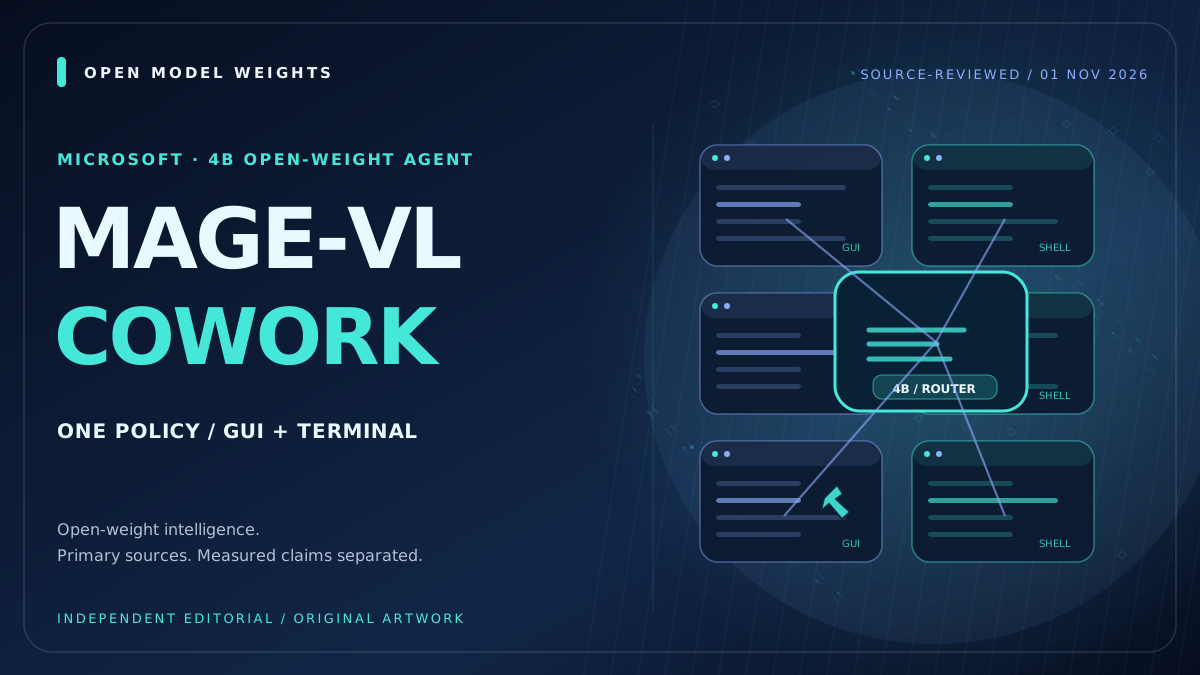
Microsoft has released Mage-VL-Cowork, a four-billion-parameter open-weight vision-language agent designed to choose between operating a graphical desktop and executing commands in a terminal. Rather than requiring a separate router to assign subtasks to a screenshot agent or a coding agent, the published policy uses both channels in one action loop. For companies exploring self-hosted computer use, that division matters: some tasks require visual interaction with a live app, while file edits, document processing and verification can be substantially more deterministic through shell tools.
The official Microsoft model card identifies an Apache-2.0 checkpoint, approximately 9.48 GB of BF16 weight files split across two Safetensors shards, and a 32,768-token active context window. Its computer_use channel operates on screenshot-grounded mouse and keyboard actions; its bash channel can use a persistent shell and Python environment. The model therefore still needs an execution harness with real applications, tool permissions and observation feedback. A published checkpoint is not a turnkey safe desktop assistant, nor should third-party tool code be trusted without inspection.
Microsoft reports a 66.0% score on OSWorld-Verified under a 50-step budget. The research describes the result as strongest among the evaluated four-billion-parameter systems. That number comes from the publisher's own setup, not an Open Model Weights benchmark, and should not be extrapolated to unrestricted production workflows. The study also reports that online reinforcement learning improved task success by 10.16 percentage points over hybrid supervised fine-tuning while reducing mean model calls and output tokens for its evaluation.
The training recipe is notable beyond one leaderboard figure. Microsoft describes a five-stage curriculum that separately develops visual and terminal skills before unifying them, backed by 293,806 synthesized desktop and web tasks covering 6,915 atomic skills. Harness design and the quality of verifiable trajectories are central parts of the claimed result. Anyone evaluating the release should reproduce tests with their actual operating system, permission boundary, browser, filesystem and human approval gates. Open Model Weights treats this as a new, source-backed computer-use model release; its model-registry eligibility and independent operational safety still require their own verification.
What this changes for the evidence layer
The original publisher repository and research project are primary evidence for downloadable weights and reported performance. No new canonical model profile or independent OSWorld reproduction is implied by this News; exact model SHA, weight files and runtime risks need independent registry and deployment review.
Microsoft Mage Team — official Mage-VL-Cowork model card
This brief is based on the cited primary source. Performance, benchmark and comparative claims remain attributed unless Open Model Weights publishes an independent measurement.
Open source article ↗