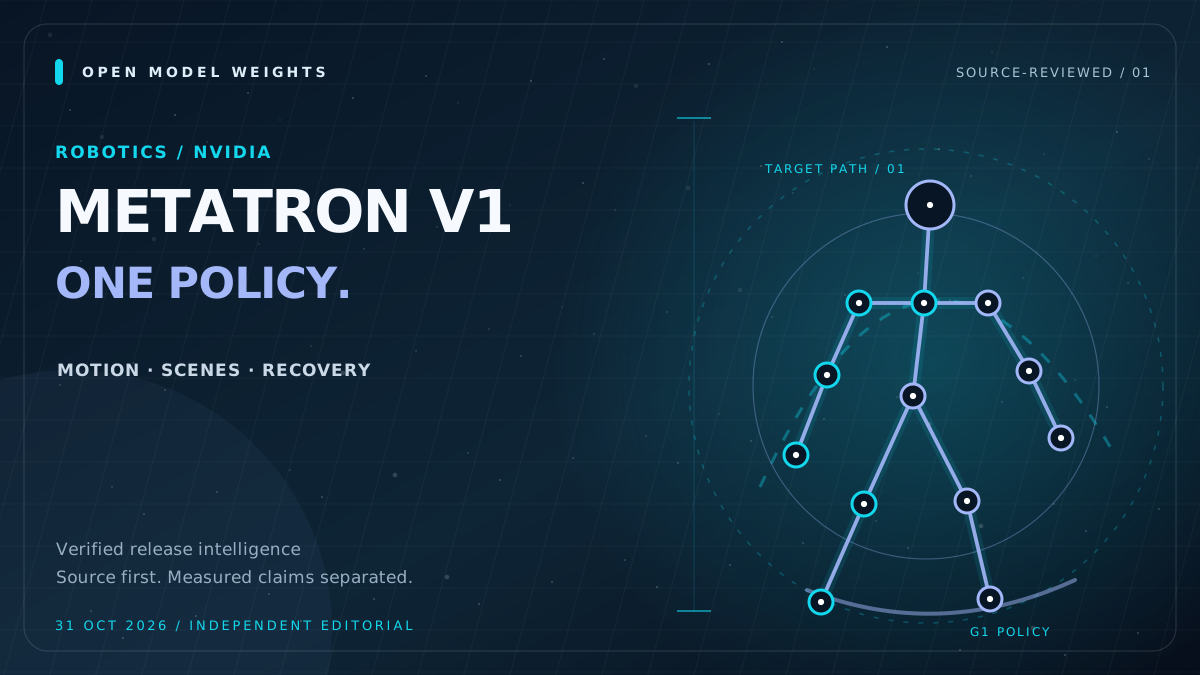
NVIDIA has released Metatron v1, a downloadable whole-body control policy for the Unitree G1 humanoid, together with a public research project and integration in NVlabs ProtoMotions. The important development is not another text-to-action chatbot. It is a learned motion controller that can respond to changing positional, velocity and timing goals without training a separate policy for each scripted movement. NVIDIA's October 28 ProtoMotions release describes steering, path following, sparse body goals, scene interaction and recovery after a fall as tasks served by the same G1 policy.
The published interface separates what a task requests from how the robot coordinates its joints. A developer or coding agent can specify where a hand or torso should move, a heading or travel velocity, and approximate arrival times. Metatron then produces coordinated whole-body movement while leaving unconstrained joints free to adapt. The research demonstration includes locomotion and upright recovery in simulation, but a goal interface is not a guarantee that the controller can safely perform an arbitrary physical task.
The original nvidia/Metatron-v1 repository provides more than a demonstration video. Its native G1 PyTorch package contains a checkpoint, resolved configuration and reconstruction instructions; the main checkpoint measures 459,455,983 bytes. Two separate ONNX exports, each approximately 403 MB, support a single-robot browser demonstration and a six-robot G1 Racer application. Both use the same learned weights, but their observation processing, action interfaces and batching differ. Substituting one export for the other or assuming that an ONNX file is a complete robot application would be incorrect.
For reproducibility and legal review, the publisher provides artifact digests and a machine-readable index. Model artifacts use the NVIDIA Open Model License, whereas the ProtoMotions code has separate Apache-2.0 terms. Neither license automatically covers third-party robot assets, motion clips or datasets. The publisher also distinguishes a browser simulation from supervised real-G1 deployment: hardware testing needs independent validation, appropriate torque limits and safety systems. Open Model Weights treats Metatron as a significant new open-weight robotics release, not as an independently tested safety-certified robot or a new verified registry entry.
What this changes for the evidence layer
NVIDIA's official Metatron-v1 repository and ProtoMotions source are primary evidence. This News does not add a model to the registry; native weights and ONNX variants need separate field-by-field intake if catalogued. Physical performance and safety have not been independently tested by Open Model Weights.
NVIDIA Research and NVlabs ProtoMotions — Metatron release
This brief is based on the cited primary source. Performance, benchmark and comparative claims remain attributed unless Open Model Weights publishes an independent measurement.
Open source article ↗