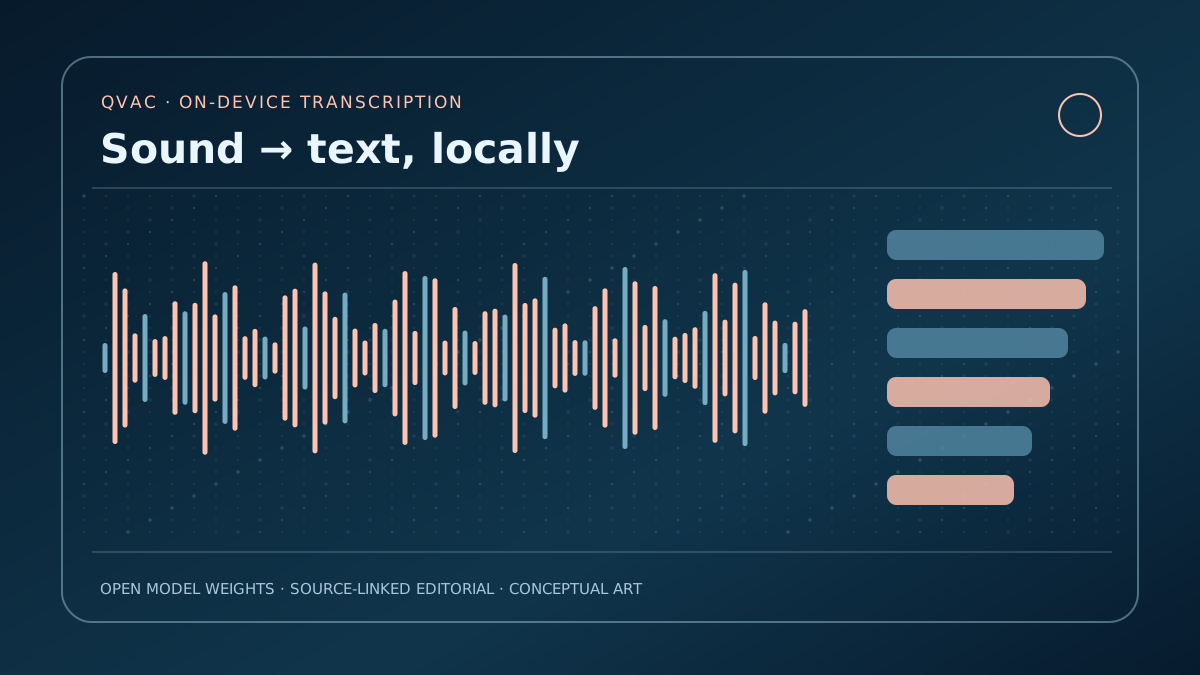
QVAC, the research initiative associated with Tether, has released TranscribePsy, a compact multilingual model for converting audio to text locally. The principal automatic speech recognition model has around 254 million parameters. It is designed for applications that may not have a reliable connection or that wish to avoid transmitting raw voice recordings to remote servers. It does not synthesize audio or operate as a general conversational assistant.
The publisher describes a laptop-oriented build for 25 European languages and a current phone-focused version for eight. Deployment artifacts include PyTorch weights, quantized GGUF models and a Core ML version intended for Apple hardware. These variants should not be treated as interchangeable: supported languages, memory footprint, decoding behavior and recognition accuracy can differ with precision and runtime.
QVAC reports strong recognition results against similarly sized competitors and quick batch transcription on tested phones. These are first-party measurements, not benchmarks reproduced by Open Model Weights. Quality should be measured separately for noisy audio, accents, mixed-language speech, long recordings and unfamiliar microphones. Transcribing a file rapidly does not establish low-latency streaming recognition; the team's public roadmap still treats streaming as future work.
The publisher says the weights are available under Apache 2.0, while downstream teams must inspect their own application licenses and speech-data processing. Inference that happens locally can reduce cloud exposure, but an app might still send transcripts or telemetry if configured to do so. Our assessment: TranscribePsy offers a useful additional choice for small multilingual ASR, provided developers check precise model files, supported languages and battery and memory performance on their intended devices.
What this changes for the evidence layer
Treat as a new candidate, not independently registry-verified. Verify official file revision, artifact-level license, runtime requirements, model scope and benchmarks before any source-first model registry promotion.
QVAC / Tether AI Research official TranscribePsy announcement
This brief is based on the cited primary source. Performance, benchmark and comparative claims remain attributed unless Open Model Weights publishes an independent measurement.
Open source article ↗