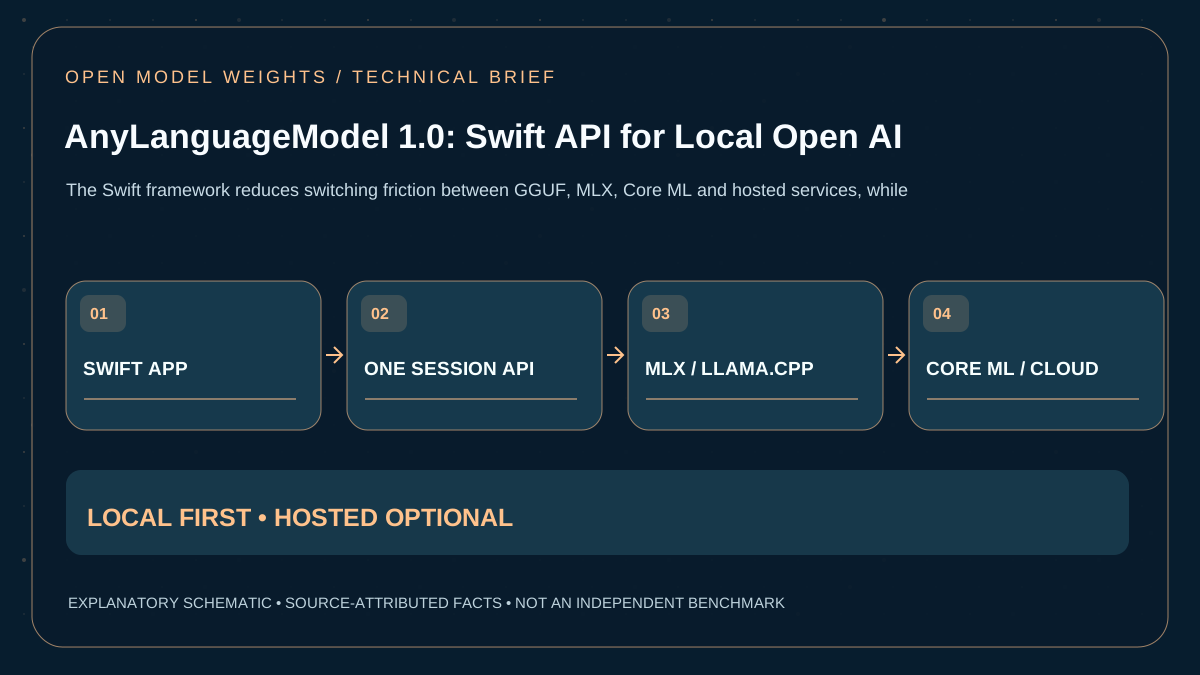
Hugging Face has released AnyLanguageModel 1.0, a Swift framework designed to let developers switch among local and hosted language models with a Foundation Models-style API. The October 20 milestone arrives with swift-huggingface 1.0 and swift-xet 1.0. Its central promise is code reuse: an app can maintain a session and replace the underlying model or inference provider without rewriting every conversation interaction.
The local options include MLX on Apple Silicon, llama.cpp for GGUF weights, Core ML and Apple's own system language models. The same framework can address remote services such as Hugging Face Inference Providers. That is useful when an app needs offline privacy for some tasks but larger hosted models for others. However, hosted inference should never be described as local execution, and common API syntax does not imply identical capabilities or privacy policies.
The release adds provider-spanning tool calling and guided generation, including structured nested output types, and image inputs where supported. Hugging Face illustrates model choice with quantized GGUF and MLX examples: a Gemma 4 E2B artifact is listed at roughly 3.4 GB, an LFM2.5 2.6B artifact at 1.7 GB, and a four-bit Qwen3.8 27B MLX variant around 16 GB, recommended for Macs with at least 32 GB of memory. File size is not peak runtime memory or a speed benchmark.
Implementation teams should inspect Swift and OS version requirements, model-card license terms, format support, tool reliability and secret handling for hosted endpoints. Open Model Weights has not independently measured any of these example deployments. Our assessment: AnyLanguageModel 1.0 is significant delivery infrastructure for open weights, not an additional model release; simpler switching makes comparative testing and hybrid application architectures easier.
What this changes for the evidence layer
A Swift application framework is not a model checkpoint. Keep original model licenses, formats, memory requirements and independent performance evidence separate.
Hugging Face official AnyLanguageModel 1.0 announcement
This brief is based on the cited primary source. Performance, benchmark and comparative claims remain attributed unless Open Model Weights publishes an independent measurement.
Open source article ↗