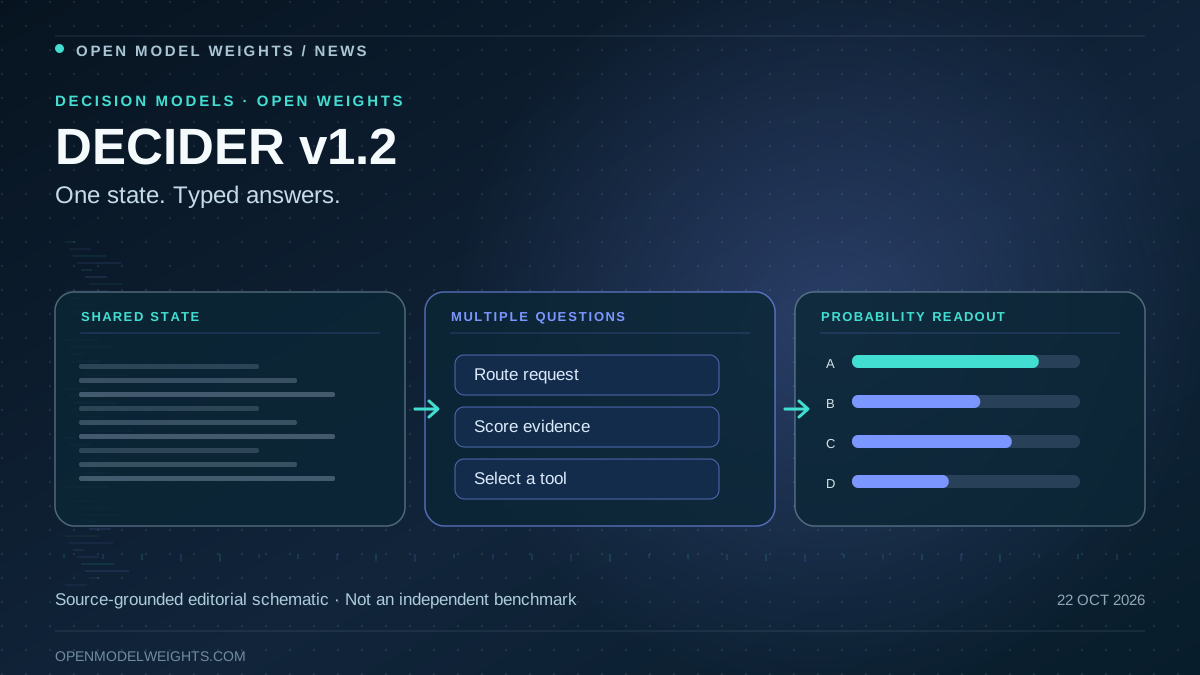
Perplexity has released the open weights for pplx-decider v1.2 in two sizes: a 27B-class model and a smaller Flash variant based on Qwen3.5-4B. Unlike a conventional chat checkpoint, these models are designed to return typed decisions and calibrated-looking probability distributions for classification, ranking and rubric scoring. The official October 19 announcement offers self-hosted weights alongside a hosted Decisions API. Both Hugging Face repositories display Apache-2.0 licensing and Safetensors artifacts; operators should still inspect the checkpoint-specific notices, dependencies and access conditions.
The central technical change is a joint request format. An application can provide shared state and several questions in one model sequence, with a dedicated readout marker for each question. That could make agent routing, document triage and repeated policy checks less expensive than generating a new prose answer for every choice. It is not interchangeable with standard next-token chat serving: the official model cards describe a separate decision readout, custom request format and attention behavior that serving integrations must reproduce.
The two models are not a free accuracy-equivalence trade. Perplexity's published Decision Index scores favor the larger version, and the Flash card warns that grouping unrelated questions can reduce its accuracy. The claimed up-to-fivefold speedup depends on the fast implementation, hardware, batching and compilation. These evaluations come from the publisher; Open Model Weights has not reproduced them or checked probability calibration on an independent production workload.
For teams deploying open-weight agents, the practical test is to compare both checkpoints against a fixed suite of real routing and escalation decisions, measuring calibration, cost, false positives and latency. Inspect the public model cards for exact file formats and operating requirements, avoid treating an API-only feature as a weight capability, and select the smaller checkpoint only when its measured error costs are acceptable.
What this changes for the evidence layer
Consider the exact official 27B and Flash Safetensors repositories for selective source-and-license verification before any canonical model intake; News publication alone does not add registry entries.
Perplexity official Decisions API and open-weights v1.2 announcement
This brief is based on the cited primary source. Performance, benchmark and comparative claims remain attributed unless Open Model Weights publishes an independent measurement.
Open source article ↗