NVIDIA introduced Kumo Forecast on October 21 as an open time-series forecasting model with an optional historical-retrieval pathway. The release goes beyond ordinary language generation: it targets multivariate measurements such as demand, telemetry or other sequential business signals. Its most distinctive design choice is to combine a pretrained temporal representation model with patterns drawn from a user's own historical dataset instead of relying only on what was learned during pretraining.
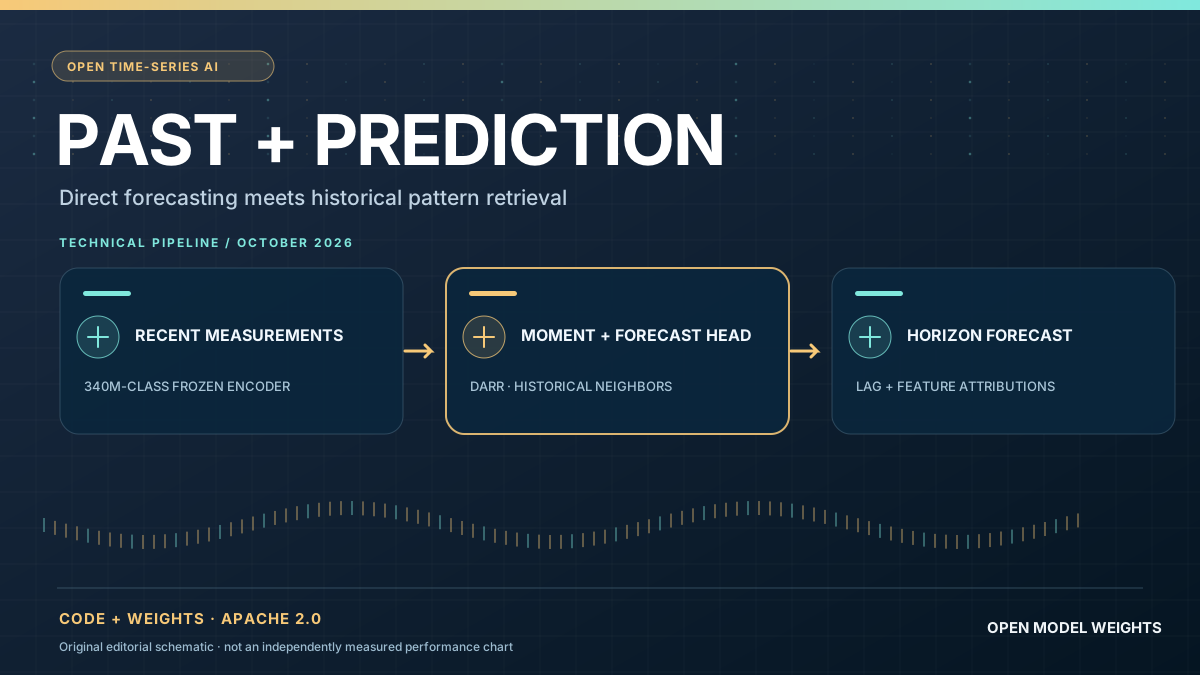
The released architecture builds on the approximately 340-million-parameter MOMENT-1-large encoder and adds a trainable forecasting head. NVIDIA describes freezing the underlying encoder and embedder during head training. The direct pathway turns recent observations into a forecast for a configured horizon. When applications need forecasts beyond the base horizon, the SDK can extend them autoregressively; these recursive predictions can accumulate error and deserve separate tests.
An optional Domain-Aware Representation and Retrieval, or DARR, pathway uses nearest-neighbor search over a separate historical DataFrame. This retrieves earlier patterns and blends their signal with the direct model prediction. An associated interpretability layer supplies horizon-specific feature and lag attributions, trajectory diagnostics and optional embedding Integrated Gradients. These tools help investigate a prediction, but an attribution output should not automatically be treated as proof of causality.
NVIDIA identifies Kumo Forecast as Apache-2.0 and provides code and weight links. Our assessment: retrieval-augmented forecasting is a relevant open-weight option for organizations with rich local history, but benefits will vary with seasonality, missing values, data leakage, distribution shift and how similar the retrieved windows really are. Benchmarking against simple seasonal and statistical baselines remains essential, and no independent Open Model Weights accuracy result is claimed.
What this changes for the evidence layer
Verify exact nvidia/Kumo-Forecast checkpoint revision, Apache-2.0 licensing, MOMENT backbone provenance, DARR context licensing and the tested horizon before canonical registry intake.
NVIDIA official Kumo Forecast engineering announcement
This brief is based on the cited primary source. Performance, benchmark and comparative claims remain attributed unless Open Model Weights publishes an independent measurement.
Open source article ↗