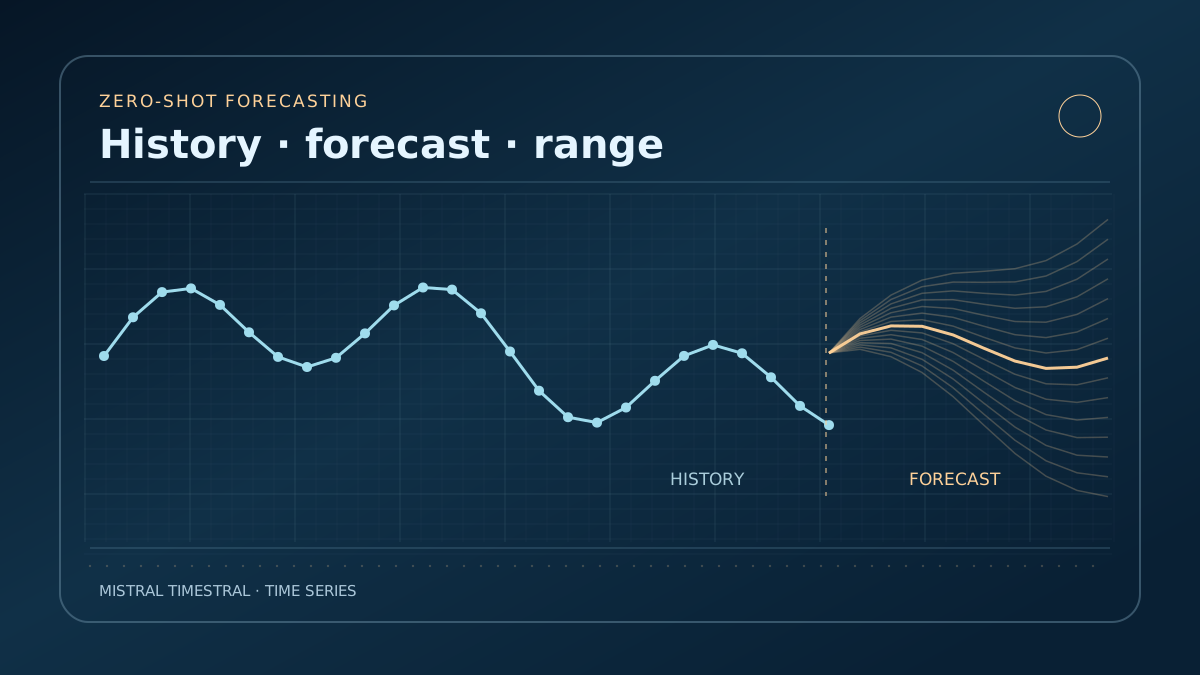
Mistral AI's Timestral release puts time-series forecasting back into the open-weight spotlight. The family spans four sizes: five million, 28 million, 123 million and 209 million parameters. These are not chat-oriented models. Instead, they forecast how measured quantities may evolve over time, which makes the release relevant to operators working on demand planning, infrastructure usage and many other practical prediction tasks.
The official model card describes a patch-based transformer with attention across both time and observed variables. Its largest variant accepts up to 32,768 historical steps and predicts up to 1,024 future steps in one forward pass. It also handles univariate and multivariate inputs, past-only and known-future covariates, and missing-value indicators. The output is probabilistic: 21 quantiles provide possible forecast ranges, rather than one apparently certain prediction.
Mistral reports a GIFT-Eval MASE score of 0.658 and TIME MASE 0.626 for the 209M model, with further comparisons across its smaller variants. These figures come from the publisher's reported benchmark suite and have not been independently reproduced by Open Model Weights. Actual forecast quality can be strongly affected by unusual events, seasonal patterns, data gaps, time resolution and prediction horizon. Test against a simple seasonal baseline on relevant held-out data.
Checkpoint files and an open implementation allow CPU or GPU experimentation, although speed and resource needs vary by size. The models use Modified MIT licensing, and its added terms should be reviewed before commercial redistribution. Our assessment: this release shows how open weights can serve narrowly defined scientific and operational uses. Stronger adoption evidence will come from reproducible real-world calibration and better predictions, not from language-model leaderboards.
What this changes for the evidence layer
News is not independently verified model-registry evidence. Confirm the exact upstream file revisions, license, architecture and source conditions before any model promotion or derived speed and capability claim.
Mistral AI official Timestral-209M model card
This brief is based on the cited primary source. Performance, benchmark and comparative claims remain attributed unless Open Model Weights publishes an independent measurement.
Open source article ↗