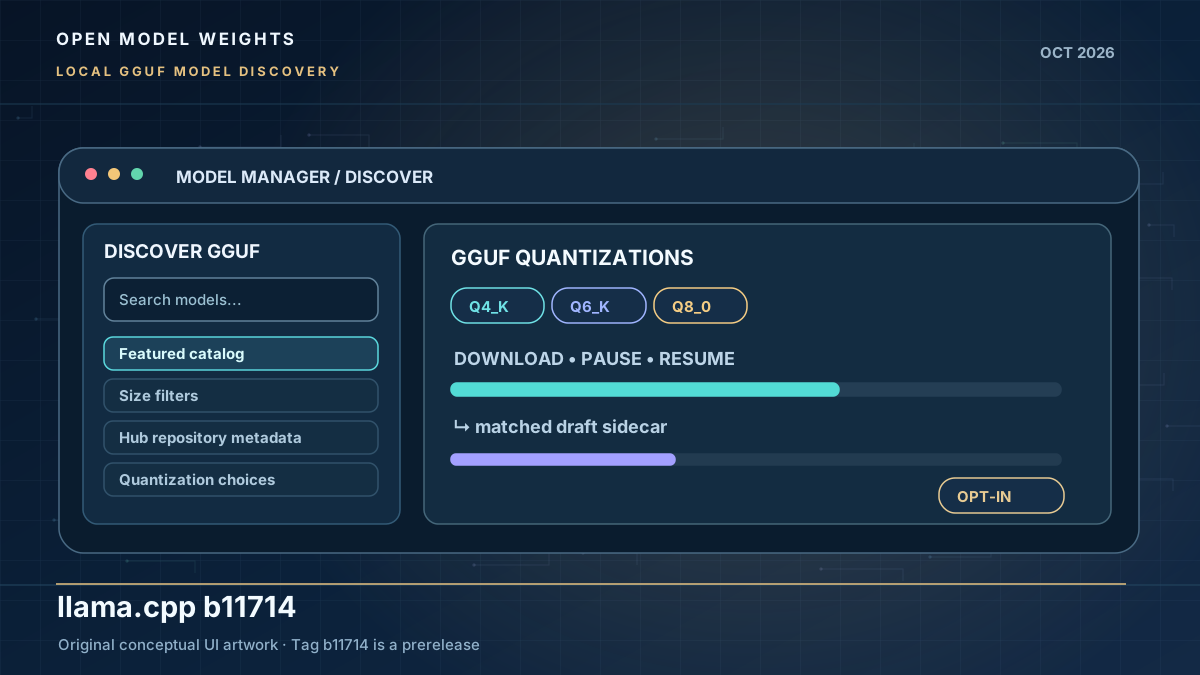
llama.cpp's October 17 b11714 prerelease adds a significant local-model usability change: an optional Discover Models panel for finding and downloading GGUF artifacts from the Hugging Face Hub. The upstream release notes link to merged pull request #29584, which documents the feature and its implementation. This builds on earlier command-line Hub download support, but adds a browse-and-manage workflow directly inside llama.cpp's model manager rather than introducing a new inference model or benchmark.
The interface offers a featured catalog, debounced search, size filters, repository details and per-quantization download controls. It also exposes Hugging Face metadata and memory-fit notes to help operators choose a GGUF file. These are selection aids, not evidence that a model actually fits a particular GPU or achieves a particular tokens-per-second rate. The repository README shown in the UI is sanitized; any third-party model still needs a source, license and artifact review.
A more technical addition concerns speculative-decoding draft sidecars. The merged code can discover draft files matched to the chosen main quantization, prefer DFlash over MTP when appropriate, and download the paired artifacts as a managed cluster. Pausing keeps partial transfer data for resumption. Cancelling or deleting the main download can cascade to its associated draft files while leaving other quantizations intact. These changes address common failure states in large model downloads, but are documented behaviors rather than independent transfer tests here.
Discover Models is off by default, and the implementation filters out decision-model repositories because the UI cannot run them. b11714 is also explicitly a prerelease tag, so production users should check the installed version and regressions before relying on the new workflow. For Open Model Weights, the main editorial consequence is a cleaner route to locate GGUF files—not a reason to treat discovered community conversions as equivalent to a verified publisher checkpoint.
What this changes for the evidence layer
This is a runtime user-interface and download-management change, not evidence that any newly surfaced GGUF repository is source-verified or safe to execute. The catalog is an access path to third-party Hugging Face assets. Our registry must still distinguish original publisher weights from community quantizations, check source lineage, license and specific files, and avoid interpreting a UI memory-fit label as a verified inference benchmark.
llama.cpp official b11714 prerelease notes and merged implementation
This brief is based on the cited primary source. Performance, benchmark and comparative claims remain attributed unless Open Model Weights publishes an independent measurement.
Open source article ↗