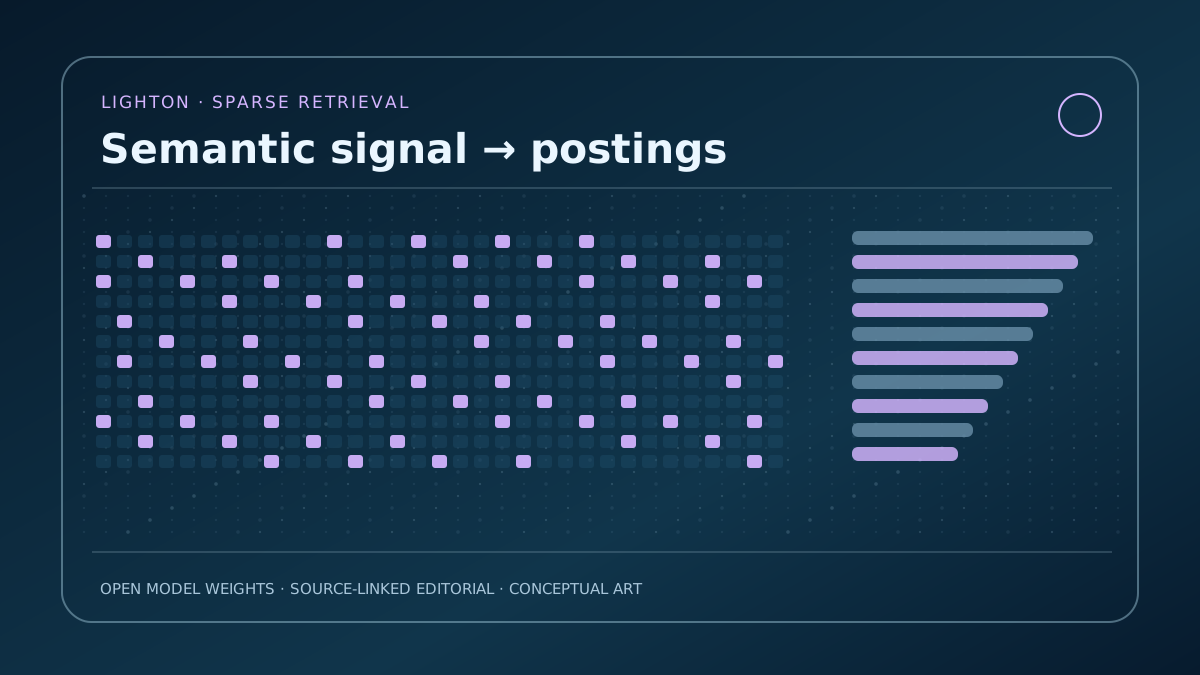
LightOn has released SlideOn and mSlideOn, two open-weight retrieval models designed to make semantic search compatible with sparse indexing. SlideOn contains around 174 million parameters and targets English retrieval, while mSlideOn has about 339 million and extends to multilingual, longer-document and code search. These are specialized search components, not general-purpose generative language models.
Conventional dense retrieval compresses a query and a document to numerical vectors. Late-interaction systems retain more token-level information but can demand substantial storage and computation. Sparse retrieval activates a limited set of dimensions, letting an inverted index identify promising documents. LightOn derives these systems from its earlier DenseOn and mLateOn work and also distributes sparse-autoencoder artifacts, including SlideOn-SAE and mSlideOn-SAE.
The team reports 56.68 on BEIR-15 for SlideOn, against 56.20 for its specified DenseOn comparison. It also describes multilingual retrieval improvements relative to an earlier dense baseline. These figures are publisher evaluations; Open Model Weights has not repeated them. Corpus language, domain vocabulary, chunk size and sparse-index configuration may change both relevance and serving costs. Multilingual capability does not imply uniformly strong performance in every script.
Operational adoption requires matching the correct document and query encoding procedure, storing sparse vectors and configuring an index that supports the chosen format. Users should check individual model and training-artifact licenses directly before commercial redistribution. Our assessment: these weights add a useful alternative to dense vectors and expensive multi-vector indexes. The central question is not a benchmark leaderboard alone but whether they improve a real search workload at acceptable latency and storage cost.
What this changes for the evidence layer
Treat as a new candidate, not independently registry-verified. Verify official file revision, artifact-level license, runtime requirements, model scope and benchmarks before any source-first model registry promotion.
LightOn AI official SlideOn and mSlideOn model checkpoints
This brief is based on the cited primary source. Performance, benchmark and comparative claims remain attributed unless Open Model Weights publishes an independent measurement.
Open source article ↗