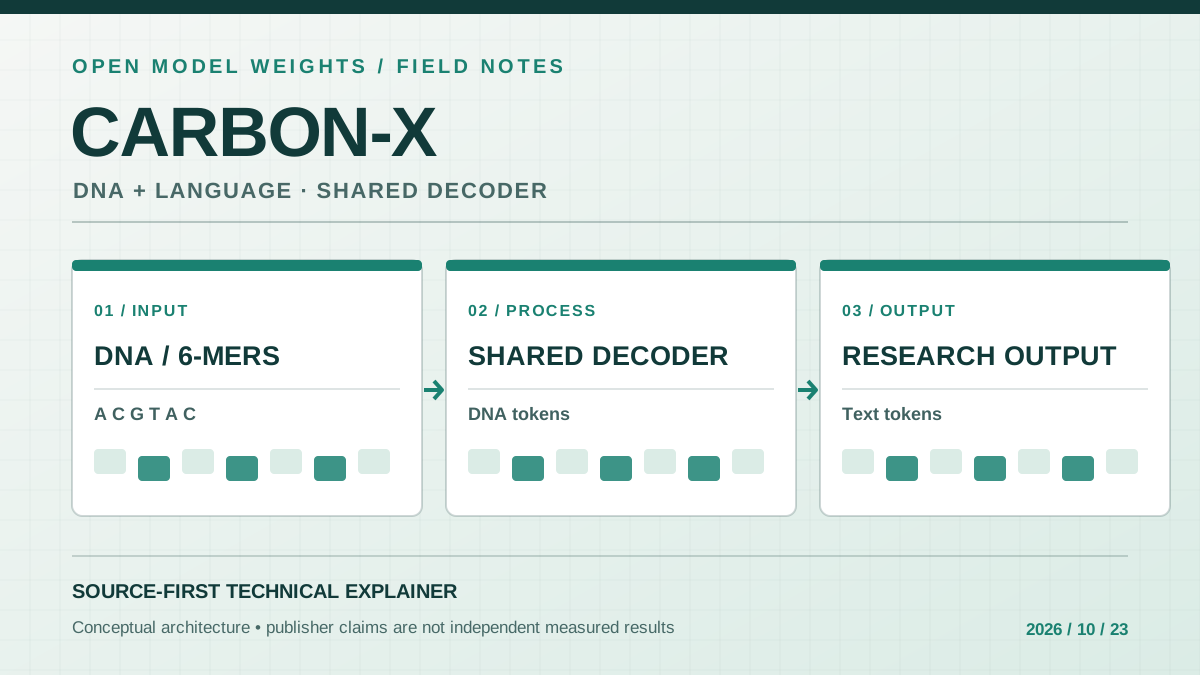
Hugging Face Biology Research has published Carbon-X, an open-weight language model designed to answer questions about DNA sequences as well as generate and interpret genomic text. The 14.8-billion-parameter decoder was adapted from the Qwen3-14B family and trained on both biological sequences and natural-language material. The official repository identifies Apache-2.0 licensing. The important distinction is that this is not merely a biology chatbot connected to a search index: DNA and English occupy the same model token stream.
The technical hinge is a hybrid tokenizer. Ordinary prose retains a BPE vocabulary, while DNA is grouped into non-overlapping six-base units, with special markers delimiting sequences. Hugging Face reports mid-training on roughly 302 billion tokens followed by supervised and reinforcement-learning stages for sequence operations and variant-related tasks. The model card lists 40,960 context positions and describes serving BF16 weights on a single 80 GB GPU, but an actual deployment must budget separately for cache, preprocessing and concurrent requests.
The publisher presents an average 66.7% across five DNA benchmarks with extended reasoning disabled, compared with its selected baseline models. Those figures come from the project's own test design; Open Model Weights has not reproduced the experiments. A DNA sequence answer is not a diagnosis, and the researchers explicitly distinguish computational predictions from biological validation. Questions about pathogenicity or regulatory effects require external evidence, appropriate review and, where relevant, laboratory confirmation.
For open-weight researchers, Carbon-X provides a testable route to local, auditable genomic assistance without transmitting unpublished sequences to a hosted model provider. Before integrating it, pin the exact repository revision, examine the model card and training scope, benchmark relevant organisms and mutation classes, and track unsupported explanations. It is a substantial addition to the open biology stack, but not a substitute for established scientific methods.
What this changes for the evidence layer
The Carbon-X model already has a source-verified canonical model page; do not add a duplicate. Evaluate any new repository revision separately without inventing clinical validity.
Hugging Face Biology Research official Carbon-X model card
This brief is based on the cited primary source. Performance, benchmark and comparative claims remain attributed unless Open Model Weights publishes an independent measurement.
Open source article ↗