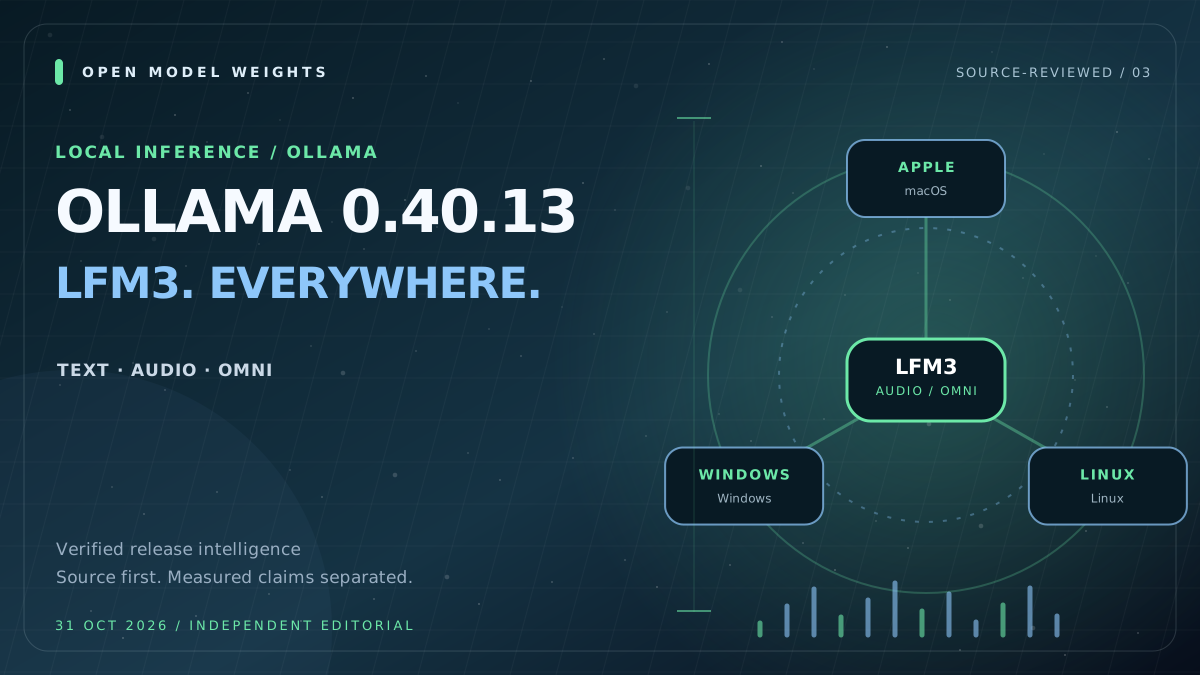
Ollama's October 28 v0.40.13 release expands support for Liquid AI's LFM3 family to Linux and Windows, alongside the Apple Silicon pathway introduced in the preceding version. The most important change is practical access to local multimodal inference, not a new foundation-model checkpoint. Developers who rely on Linux workstations, Windows PCs or their existing Ollama installation can now test more of the same open-weight family without assuming that a Mac is the only supported host.
The maintainer release notes explicitly mention lfm3-audio and lfm3-omni, including text-to-speech use cases. Liquid AI's LFM3 line is broader than an ordinary chat model: family releases include a compact text backbone as well as variants for visual input, speech processing, multimodal interactions and structured decisions. Those are different model packages with distinct interfaces and resource requirements. This update concerns Ollama's ability to run published models; it does not turn every LFM3 checkpoint into a single universal audio-and-vision model.
There is a useful distinction from Ollama's earlier speech announcement. The October 24 v0.40.11 release introduced macOS speech output with the Phonon model and an OpenAI-compatible speech endpoint. The subsequent LFM3 support broadens another family of models and should not be described as the first time Ollama gained speech synthesis. Nor does the version number establish equivalent performance or precisely the same accelerated kernels across Apple, Windows, NVIDIA GPUs and Linux hardware. Platform support needs to be tested together with the installed backend and the chosen quantization.
For developers, the sensible next step is to pin Ollama v0.40.13 or later, choose the exact named LFM3 variant and run representative speech or multimodal workloads on the target machine. Measure first-audio latency, memory consumption, streaming behavior and output quality rather than relying on compatibility alone. The applicable LFM Open License also belongs to the checkpoint, not the Ollama runtime. Open Model Weights covers this as a significant accessibility improvement for existing downloadable models, with no invented benchmark results or new model registry entries.
What this changes for the evidence layer
Runtime capability only: the official Ollama tag is the primary evidence. No newly verified model revision is implied. Validate individual LFM3 weight and license files, supported backends and real audio use-case performance separately.
Ollama official v0.40.13 release notes
This brief is based on the cited primary source. Performance, benchmark and comparative claims remain attributed unless Open Model Weights publishes an independent measurement.
Open source article ↗