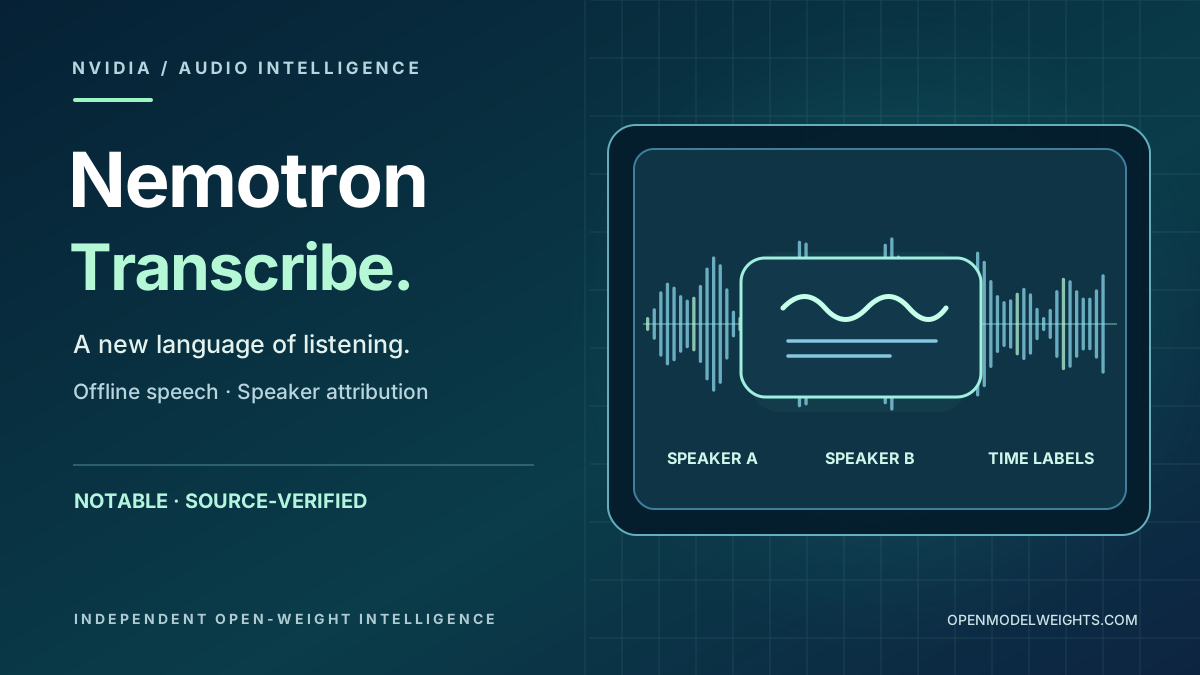
Open Model Weights has added NVIDIA Nemotron 3.5 Transcribe 30B-A4B to its specialist Notable collection. We highlight this release because it provides an official downloadable checkpoint for a specific task: transforming recorded speech into useful, attributed text. NVIDIA introduced the model on October 28 with technical documentation and OpenMDW-1.1 model terms. Our new registry record covers the original NVIDIA BF16 repository and its verified files; accompanying FP8, NVFP4, GGUF and optional draft artifacts remain different distributions, not additional independent Leading models.
The model brings together a speech encoder, speaker-oriented components and a sparse Nemotron language backbone. NVIDIA describes approximately 34 billion total parameters across the audio-language system and 4.3 billion active. It supports instructions for verbatim transcription, normalized written text, translation, language identification, audio questions, speakers and word-level timing. The publisher describes 40 supported languages and up to one-hour recordings. This is a batch-oriented offline model; segmenting audio inside a serving stack does not establish low-latency live-streaming recognition.
NVIDIA reports mean word error rates of 4.71 percent for selected English Open ASR tests and 4.62 percent for its multilingual selection, along with separate speaker-overlap and prompted-vocabulary evaluations. These are vendor-reported results, not Open Model Weights measurements. Some high-throughput Blackwell/NIM results depend on serving optimizations NVIDIA notes are not yet part of the open release. Real transcription performance depends on language, noise, speakers, audio preprocessing, device memory and the precise checkpoint.
Notable is therefore a more accurate classification than Leading: the release is relevant for transcription and multilingual speech operations, but we have not reviewed a checkpoint-equivalent independent speech comparison establishing category leadership. The source profile preserves the original OpenMDW-1.1 conditions, including notices, redistribution and component-related obligations. Organizations should verify consent and personal-data handling for recordings and run matched tests for diarization quality, latency and memory before using the model in production.
What this changes for the evidence layer
The Notable listing points to a verified original NVIDIA Nemotron 3.5 Transcribe BF16 repository, its source SHA, file manifest and conditional OpenMDW-1.1 license. Manufacturer benchmark and throughput claims are not independent OMW test results.
NVIDIA Research — Nemotron 3.5 Transcribe
This brief is based on the cited primary source. Performance, benchmark and comparative claims remain attributed unless Open Model Weights publishes an independent measurement.
Open source article ↗