The vLLM Semantic Router team has published d3-ultra, an open-weight multimodal checkpoint that specializes in bounded decisions rather than ordinary chat. The official repository lists 26.09 billion total parameters, including a 0.46-billion-parameter vision encoder, downloadable Safetensors and Apache-2.0 terms. A caller supplies an input plus explicit questions, and the model returns probabilities or located objects without drafting free-form prose. This checkpoint is distinct from DecisionFormer, the decision-model training framework already covered by Open Model Weights.
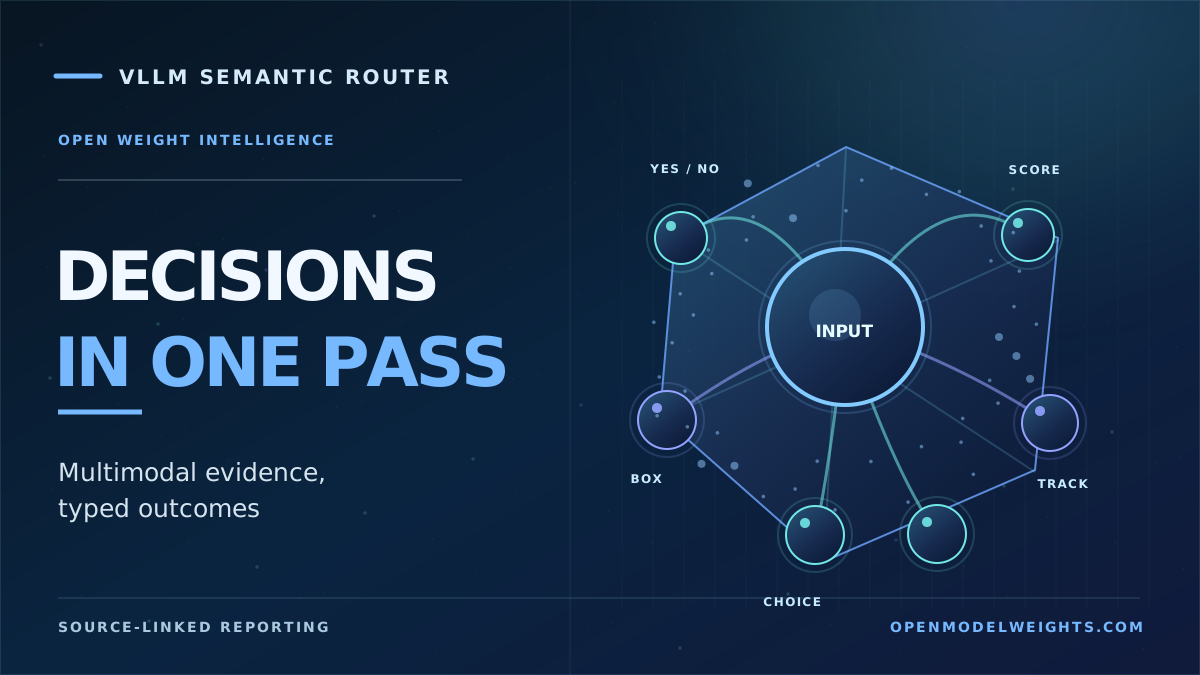
Inputs can include text or JSON, photographs and video. A question can ask the model to choose among options, answer yes or no, select a score, find a visual box or track an object over a clip. The project says the input is read once for multiple associated questions and lists a context limit of 131,072 tokens per question. Such a stated limit does not prove consistently accurate reasoning near that boundary, or reliable preprocessing of every image or video format.
The authors publish response-time measurements for multiple questions about the same picture on an AMD Instinct MI325X and comparisons on SR-Text and SR-Box. The repository explicitly describes these benchmarks as its own tests using private question sets. They should not be treated as independently reproduced routing quality, calibration or production throughput. A typed probability may be easier to consume than a text explanation but can still be inaccurate, biased or poorly calibrated on unfamiliar inputs.
For application builders, the sensible experiment is to compare d3-ultra with a prompt-and-parse baseline on representative requests, including abstentions, class-wise errors, visual grounding, latency, memory and safety. The official Transformers quickstart permits repository code execution, so that code must be reviewed before loading. Model revision, exact format and legal terms also need verification. The release expands the available self-hosted decision stack; Open Model Weights does not report independent benchmark results or create a canonical verified model record from this article.
What this changes for the evidence layer
Downloadable model candidate only. Review pinned Safetensors, code, model/license provenance, and independently reproduced calibration before registry intake.
vLLM Semantic Router official d3-ultra model card
This brief is based on the cited primary source. Performance, benchmark and comparative claims remain attributed unless Open Model Weights publishes an independent measurement.
Open source article ↗