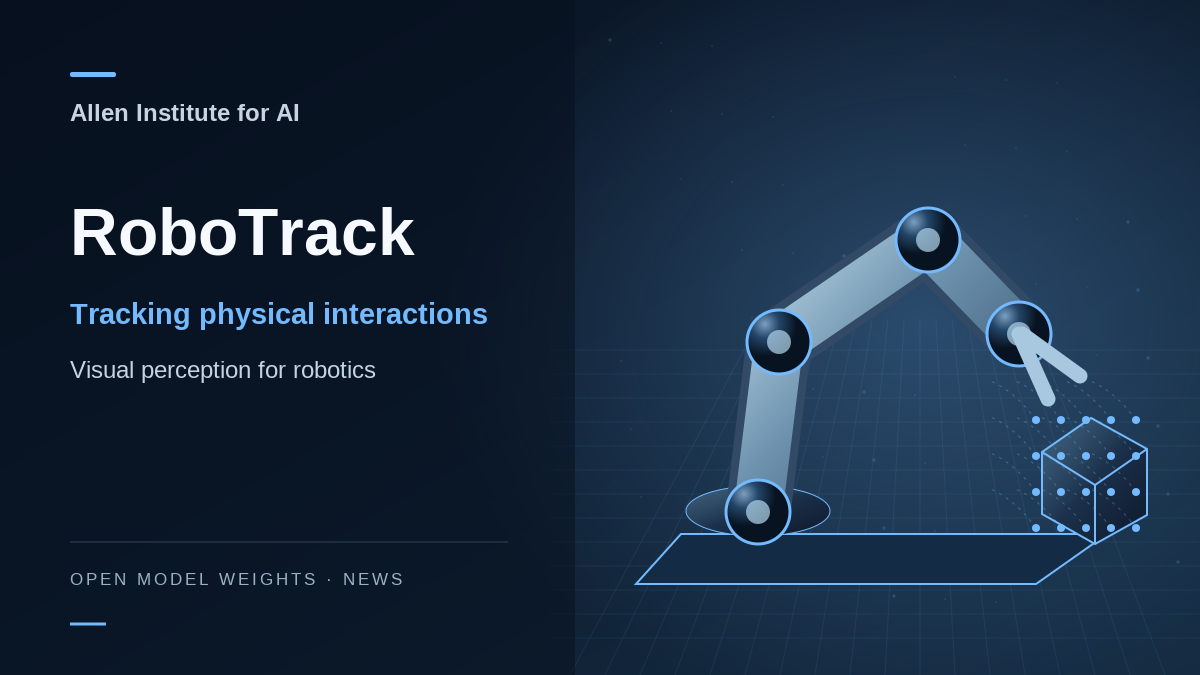
The Allen Institute for AI has introduced RoboTrack, a research project focused on visual point tracking in robotic manipulation. Its November 23 announcement addresses a practical challenge for embodied AI: tracking how specific points on objects move during an interaction. This type of visual information can help downstream systems reason about object motion and contact, but it is not a substitute for a complete robotics control system. Primary source ↗
Tracking in ordinary videos and tracking during physical manipulation are related but distinct tasks. A robotic gripper may obscure part of an object, deform a material, move it across a scene or expose surfaces that were previously invisible. A tracker that works well on general video benchmarks may not necessarily perform equally well when such events occur. Task-specific evaluation is therefore important.
Ai2's announcement describes comparisons involving CoTracker3, BootsTAPNext, AllTracker and CoWTracker on RoboTrack-Bench alongside other manipulation and general-video benchmarks. The value of this work is not simply the introduction of another score; it is the opportunity to examine how tracking systems behave across different types of motion and interaction. Benchmark comparisons remain attributable to the authors.
The project introduces RoboTracker and RoboTracker-Warp alongside training and evaluation resources. Developers interested in integrating these artifacts should examine the documented input and output representations, model dependencies, exact checkpoint revisions and the terms governing each model and dataset. Dataset access and model-weight licensing are separate questions.
For Open Model Weights, RoboTrack is a relevant example of specialized perception research that can complement general multimodal models. Future evaluations should distinguish visual tracking performance from downstream robot success and should include representative physical conditions. Open Model Weights has not run the models or reproduced the reported comparisons. No checkpoint or benchmark result should be interpreted as evidence of autonomous operational safety.
What this changes for the evidence layer
Review each tracking checkpoint and dataset license independently. Point tracking is a perception component, not an autonomous controller or certified safety system.
Allen Institute for AI — official RoboTrack announcement
This brief is based on the cited primary source. Performance, benchmark and comparative claims remain attributed unless Open Model Weights publishes an independent measurement.
Open source article ↗