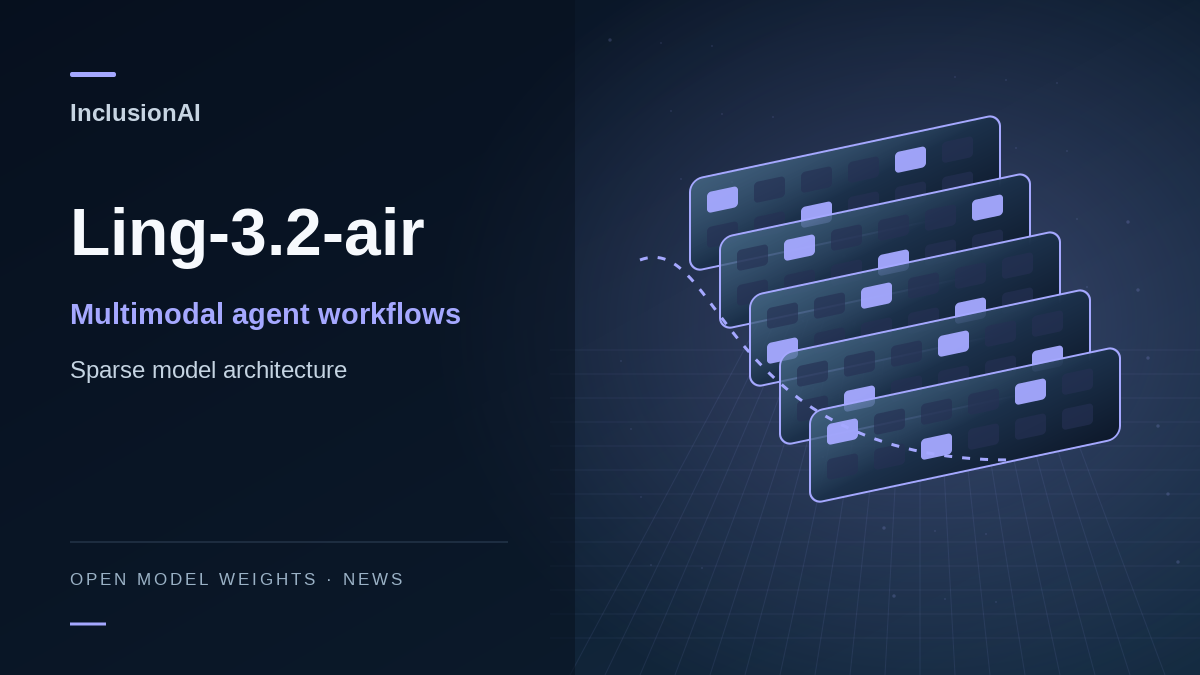
InclusionAI has introduced Ling-3.2-air, an open-weight multimodal model for workflows that combine text with visual information. Its public model card describes the same native multimodal architectural direction as Ling-3.0-flash-VL. The release is particularly interesting for developers working on document processing and agents that need to interpret visual context instead of relying solely on textual input. Primary source ↗
Reported architecture figures describe a sparse mixture of experts with roughly 124 billion total parameters and 5.5 billion active parameters per token. This distinction is central to evaluating the model. Sparse activation can reduce the amount of computation needed for an individual token, but it does not imply that the complete checkpoint occupies the memory of a dense 5.5B model. Hardware sizing still depends on total weights, numerical precision, cache behavior and the serving system.
InclusionAI's documentation reports an Artificial Analysis Intelligence Index v5.0.1 score of 23. That figure is a model-card claim rather than a benchmark run conducted by Open Model Weights. A general index also cannot establish whether a model can perform a particular business workflow reliably, especially when tool execution, document quality or long sequences introduce additional sources of error.
For an organization evaluating an agent system, useful tests would include field-level accuracy on representative documents, tool-call consistency, recovery from unexpected interface states and latency under realistic concurrency. Visual capability is only one part of end-to-end agent reliability; permissions and application-level validation remain separate requirements.
The official Hugging Face and ModelScope repositories are the starting points for evaluating the release. Before deployment or registry intake, users should check the precise weight revision, license scope and serving requirements. The model's sparse architecture makes it a noteworthy option to investigate, not an automatic recommendation for consumer hardware or a universal performance ranking.
What this changes for the evidence layer
Confirm exact parameter metadata, full weight inventory, license text and source revision before registry intake. Artificial Analysis score quoted by the model card is not an independently repeated OMW result.
InclusionAI — Ling-3.2-air model card
This brief is based on the cited primary source. Performance, benchmark and comparative claims remain attributed unless Open Model Weights publishes an independent measurement.
Open source article ↗