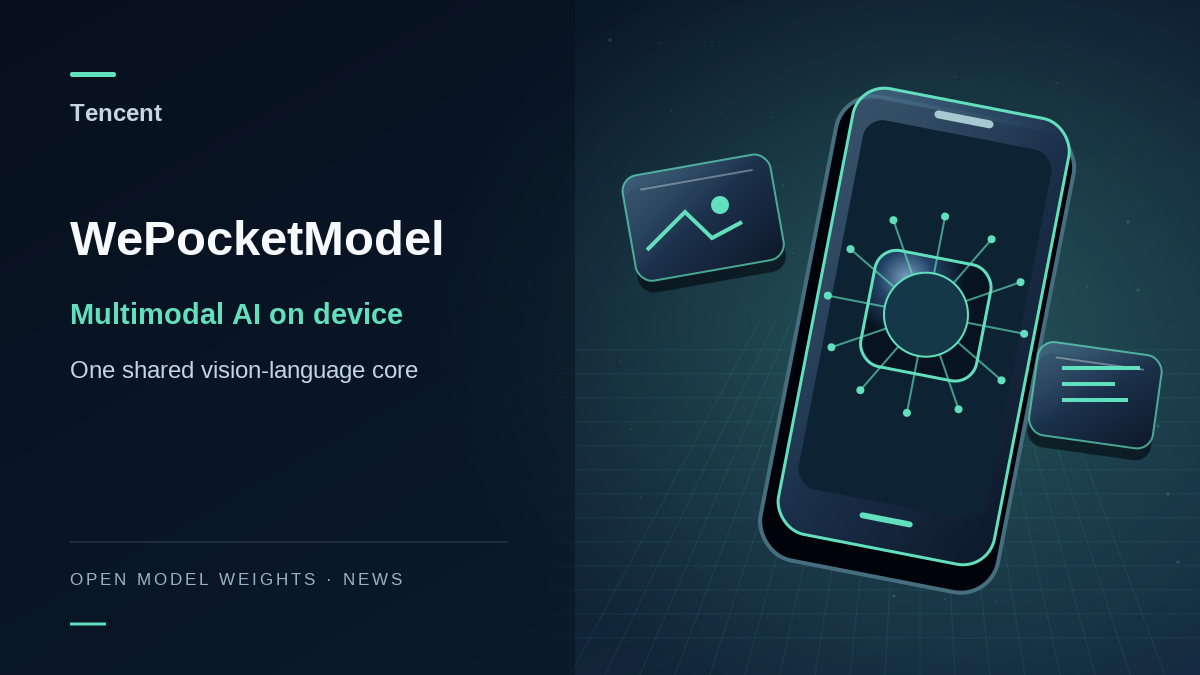
Tencent's WePocketModel project has announced the open release of version 1.0. The project describes a compact multimodal family that uses a single shared vision-language backbone, with an explicit focus on intelligence running inside applications and on users' devices. Its documented 2B and 4B model options are relevant to developers interested in keeping model infrastructure close to the application. Primary source ↗
A unified backbone is an attractive design direction because multimodal applications often involve several distinct operations: interpreting an image, responding to a prompt, extracting useful text or preparing information for retrieval. Traditionally, different specialist models may be used for different operations. A shared architecture can potentially reduce integration overhead, although developers still need to determine which tasks the particular checkpoint and inference interface support.
The project repository includes examples for running model inference using a Hugging Face identifier or local checkpoint directory, including CPU-oriented examples. That is a useful starting point for experimentation, but a working example alone does not establish practical latency, battery life or sustained performance across devices. A model that is small relative to a frontier model can still be demanding on a phone or constrained embedded system.
The deployment question is therefore as much about the runtime as the model. Quantization, image preprocessing, context length, hardware acceleration and available memory can all affect the result. Developers should test the actual combination on their target device instead of extrapolating from parameter count alone.
For the open-weight ecosystem, WePocketModel provides another concrete path to exploring compact multimodal applications outside a proprietary API. The official project and model repositories are the appropriate starting points for checking artifacts and license scope. Open Model Weights has not independently measured device-level latency or quality and does not infer commercial redistribution rights from the general open-release announcement.
What this changes for the evidence layer
Verify individual checkpoint licensing, weight formats and exact revisions before registry intake. On-device is a design objective, not a measured device-performance guarantee.
Tencent — WePocketModel project
This brief is based on the cited primary source. Performance, benchmark and comparative claims remain attributed unless Open Model Weights publishes an independent measurement.
Open source article ↗