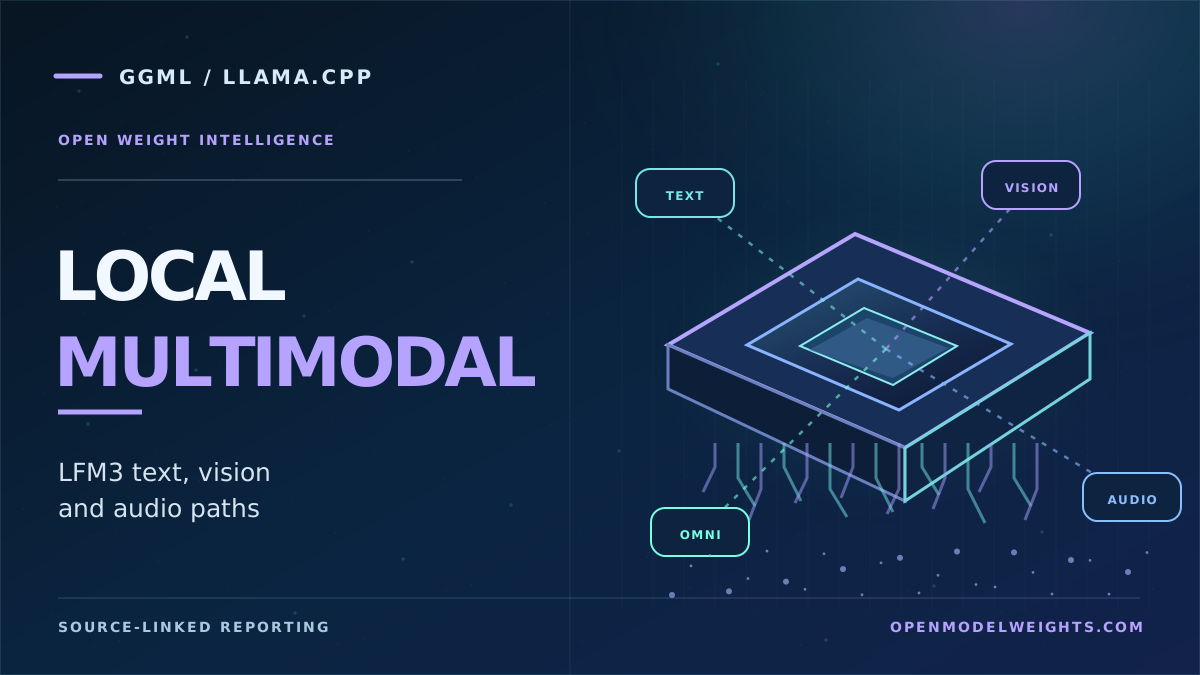
The ggml-org llama.cpp project has added local support paths for several of Liquid AI's new LFM3 model variants. October 28 changes include architecture handling for LFM3-1.7B and LFM3-VL-2B and a separate integration for LFM3-Audio-2B and LFM3-Omni-2B. This is distinct from the model-family announcement already reported by Open Model Weights: it concerns an existing self-hosted runtime's conversion and inference compatibility rather than newly released model weights, an additional independent quality test or changed licensing.
The text and vision work introduces model-specific configuration handling and recurrent-state rollback. The audio integration reads the released LFM3 audio setup and accounts for depthformer components, while the llama.cpp speech tool supports voice selection. The documentation names female and male TTS options for the relevant model and explicitly distinguishes those predefined voices from speaker cloning. Users may need companion multimodal projection assets as well as the converted core GGUF weights, depending on the selected task.
A merged pull request is a useful signal that maintainers have integrated an architecture, but it does not guarantee that every platform, low-bit format, prompt mode or combined audio-vision workload is ready for production. Runtime requirements depend on the exact checkpoint, converter revision, supporting components, acceleration backend, KV or recurrent state and device memory. Published weight-only estimates should never be mistaken for the total amount needed for complete multimodal generation.
For local-first developers, the engineering significance is a wider route to evaluating LFM3 without relying solely on hosted inference APIs. Good reporting must preserve the source distinction between the open-weight distribution and the software implementation. Operators should record their exact llama.cpp build and model revisions, test output fidelity and measure latency before claiming compatibility on specific machines. This article covers the newly merged inference paths; it does not create duplicate model entries or state independent performance rankings.
What this changes for the evidence layer
Runtime integration only. Keep the existing LFM3 article, model provenance and licensing unchanged; no new field-verified model record or hardware benchmark.
ggml-org/llama.cpp merged LFM3 audio and omni integration
This brief is based on the cited primary source. Performance, benchmark and comparative claims remain attributed unless Open Model Weights publishes an independent measurement.
Open source article ↗