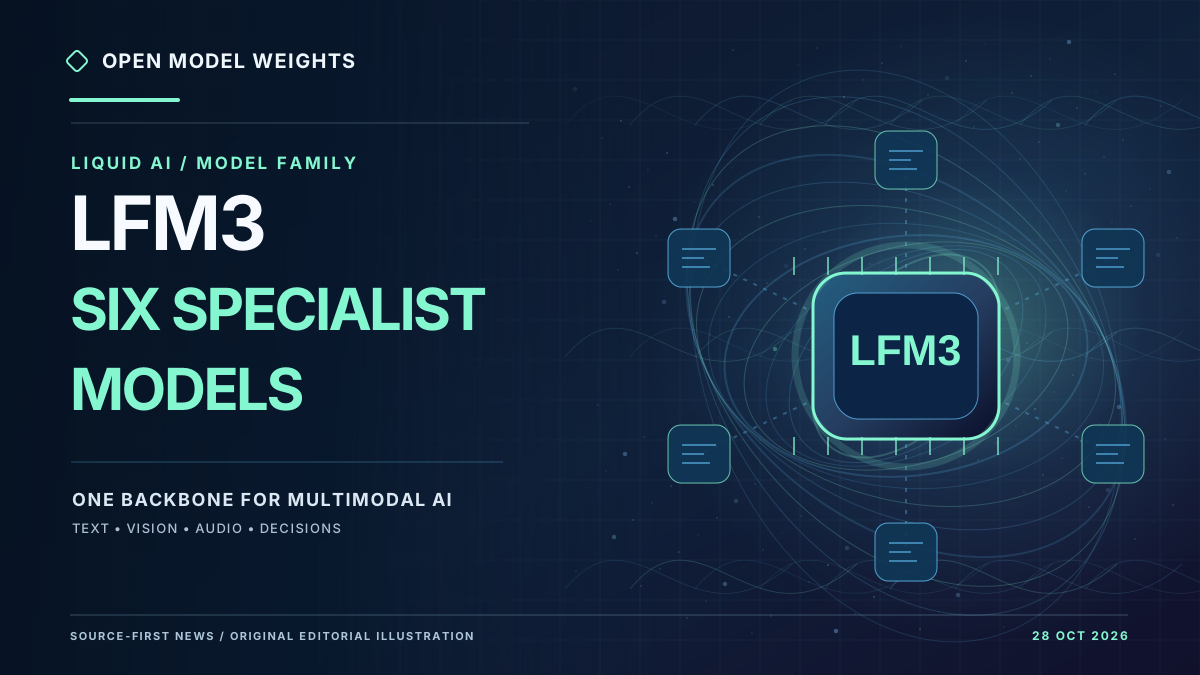
Liquid AI has introduced LFM3, a family of small specialist models designed to bring open-weight inference and fine-tuning closer to phones, laptops and constrained deployment environments. The October 27 first-party announcement describes six task-specific models built from one LFM3-1.7B-Base backbone: a text model, a vision-language variant, audio and omni models, and two decision-oriented checkpoints. This is a family of distinct model distributions, not one checkpoint that performs every modality identically. Its breadth is significant for teams that want a consistent starting point across several product surfaces.
The released LFM3-1.7B text-model card lists 1.73 billion parameters, a 256,000-token context ceiling and a tri-hybrid architecture with 13 gated short-convolution layers, five sliding-window-attention layers and six global-attention layers. The publisher positions it for tool calls, structured output and compact local agents, and offers several precision and runtime variants. The stated roughly one-gigabyte requirement applies to a quantized text-weight configuration, not an end-to-end guarantee about KV cache, activations or the memory demands of an entire agent.
Liquid also describes LFM3-VL-2B for image and video input, LFM3-Audio-2B for speech-oriented tasks, LFM3-Omni-2B for combined media, and d1-2B plus d1-omni-2B for bounded decisions. The company reports improvements over earlier LFM2 models and publishes benchmark tables, but those comparisons are publisher-run and depend on the selected test sets and harnesses. The model card explicitly cautions that its small text checkpoint is not recommended for complex agentic coding or difficult multistep reasoning. Long advertised context does not establish reliable retrieval across an entire long conversation.
For deployment decisions, the specific checkpoint, quantization, actual downloadable files and applicable terms matter more than the family name. The text repository identifies the LFM Open License v1.0, not a blanket Apache or MIT license, and the family variants require their own model-card checks. Open Model Weights treats LFM3 as a noteworthy new source-backed set of candidates; no new canonical registry entries or independent benchmarks are implied until individual weight artifacts, revisions, licenses and real hardware behavior are separately verified.
What this changes for the evidence layer
New first-party family; this News article does not create six verified OMW model records. Each released checkpoint requires separate pinned file, revision and LFM Open License v1.0 review before registry intake.
Liquid AI official LFM3 family announcement on Hugging Face
This brief is based on the cited primary source. Performance, benchmark and comparative claims remain attributed unless Open Model Weights publishes an independent measurement.
Open source article ↗