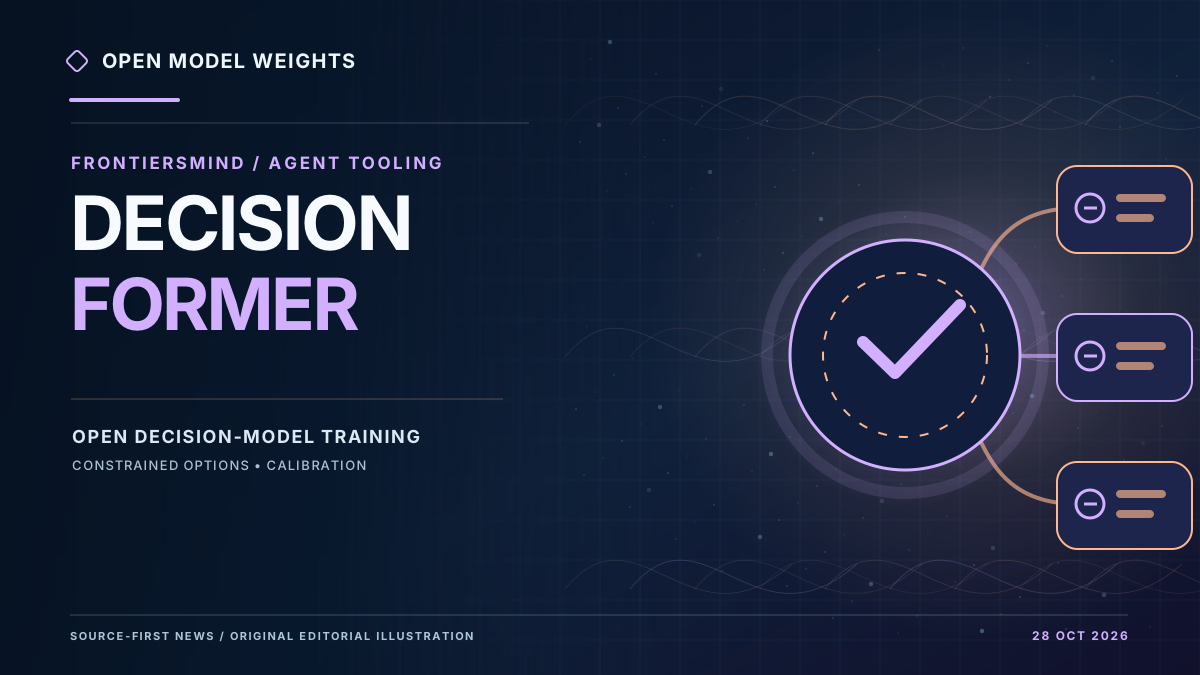
FrontiersMind has released DecisionFormer, an Apache-2.0 framework for adapting supported pretrained models to constrained decisions rather than unconstrained prose. Its October 26 technical announcement describes a configurable training system with full fine-tuning, LoRA and QLoRA, plus several output heads and attention modes. This is an open-source engineering tool, not the publication of a single new foundation-model checkpoint. Its significance is that teams can experiment with bounded agent decisions using their existing model backbones and inspect the resulting parameters and serving behavior.
A decision request supplies a state and an explicit set of permitted answers. The framework reads option scores in a forward pass, returning a probability distribution for a choice, yes/no gate or ordered rating. Restricting responses to predefined codes avoids malformed free-text labels and parsing retries; it does not prove that the chosen option is accurate or safe. The project uses a /v1/systemone-style interface and publishes a deciformer-15k dataset mix alongside training examples, so users can assemble and evaluate their own decision checkpoints.
DecisionFormer's documentation distinguishes causal, bidirectional and prefix-bidirectional attention. Bidirectional access can help a model consider the entire known question at once, but changing a causally pretrained decoder's attention pattern is not automatically an improvement. FrontiersMind specifically advises comparing against a causal baseline, and some supported backbones need additional adaptation. Likewise, temperature-calibrated probabilities should be evaluated on genuinely held-out, representative examples rather than treated as intrinsically trustworthy confidence estimates.
For open-weight agent builders, the interesting use cases include task routing, tool selection, escalation gates and structured classification where stable output contracts matter. A responsible trial needs task-specific accuracy, class-wise errors, calibration measures, actual latency and adversarial input tests before automation. Inputs and downstream policy checks must remain outside the model's trust boundary. Open Model Weights regards this as an actionable tooling release, while refraining from inventing a new verified model entry or turning the project's claimed results into an independent benchmark.
What this changes for the evidence layer
Framework and dataset release, not a newly verified model checkpoint. Trained derivatives have their own base model, licenses, files and revision provenance; no new canonical OMW model or performance measurement is created by this News.
FrontiersMind official DecisionFormer technical announcement
This brief is based on the cited primary source. Performance, benchmark and comparative claims remain attributed unless Open Model Weights publishes an independent measurement.
Open source article ↗