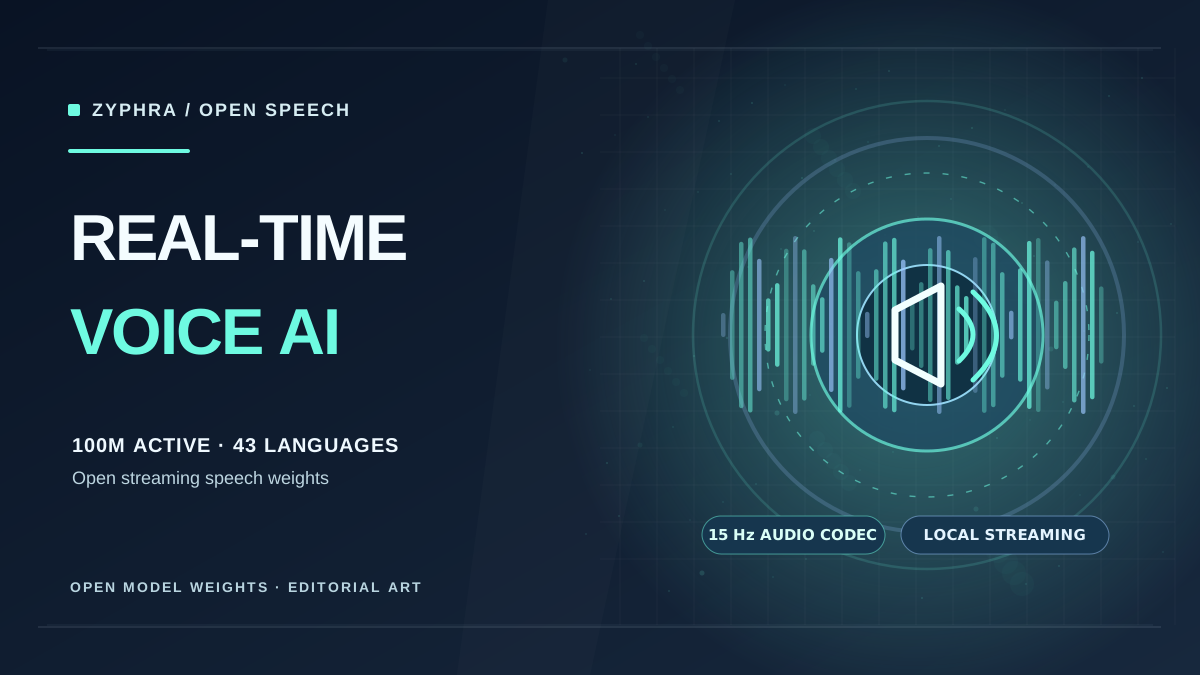
Zyphra has published ZONOS3-Mini, an open-weight speech generator intended for streaming text-to-speech, multilingual delivery control and zero-shot voice cloning. Its November 12 release is substantive because downloadable model artifacts and multiple local inference paths accompany the announcement. Zyphra labels the model weights Apache-2.0 and the reference runtime code MIT. That separation matters: a developer can inspect the stated weight rights and implementation terms without treating a marketing demo as proof of independently tested quality or safety. Primary source ↗
The model combines a 15 Hz semantic-acoustic codec, ZAC-1, with an approximately 800-million-parameter sparse backbone that activates around 100 million parameters per token. Zyphra describes a hybrid of Gated DeltaNet and attention layers, with latent mixture-of-experts routing and a 44.1 kHz audio decoder. It supports either a reference-audio prefix or a compact speaker embedding for conditioning. The team reports 43 supported languages, while pronunciation, speaker consistency and multilingual robustness still require testing under each product's actual inputs.
Open artifacts cover BF16 weights, quantized GGUF variants, a plain PyTorch reference, Apple Silicon MLX, C++/ggml, a WebGPU browser path and SGLang-Omni server integration. Zyphra reports time to first audio below 570 milliseconds in a Pixel 9 browser, below 150 milliseconds on an M3 MacBook Air and 80 milliseconds median on one H100 in its stated conditions. The newly published ZTTS2-Eval also places the model highly among compared open systems. All those figures and rankings are issuer-reported; Open Model Weights has not rerun the evaluations or validated continuous conversational latency.
For teams building an on-device assistant, the operational question is whether real voices can be synthesized reliably, with acceptable memory demand, streaming interruption behavior and clear authorization. Voice-cloning products need speaker consent, anti-impersonation controls and auditability rather than relying only on fast audio. Our existing ZONOS3-Mini registry record should be checked against the fresh release's exact repository revision, component licenses and GGUF file list; the new article is not an independent benchmark or an automatic Leading upgrade.
What this changes for the evidence layer
Existing ZONOS3-Mini registry entry: check latest Zyphra/ZONOS3-Mini and Zyphra/ZONOS3-Mini-hf revision SHAs, weights, codec and GGUF files, runtime MIT notices, license text and model-versus-system latency. No new unverified model record or Leading change.
Zyphra research team — official ZONOS3-Mini release
This brief is based on the cited primary source. Performance, benchmark and comparative claims remain attributed unless Open Model Weights publishes an independent measurement.
Open source article ↗