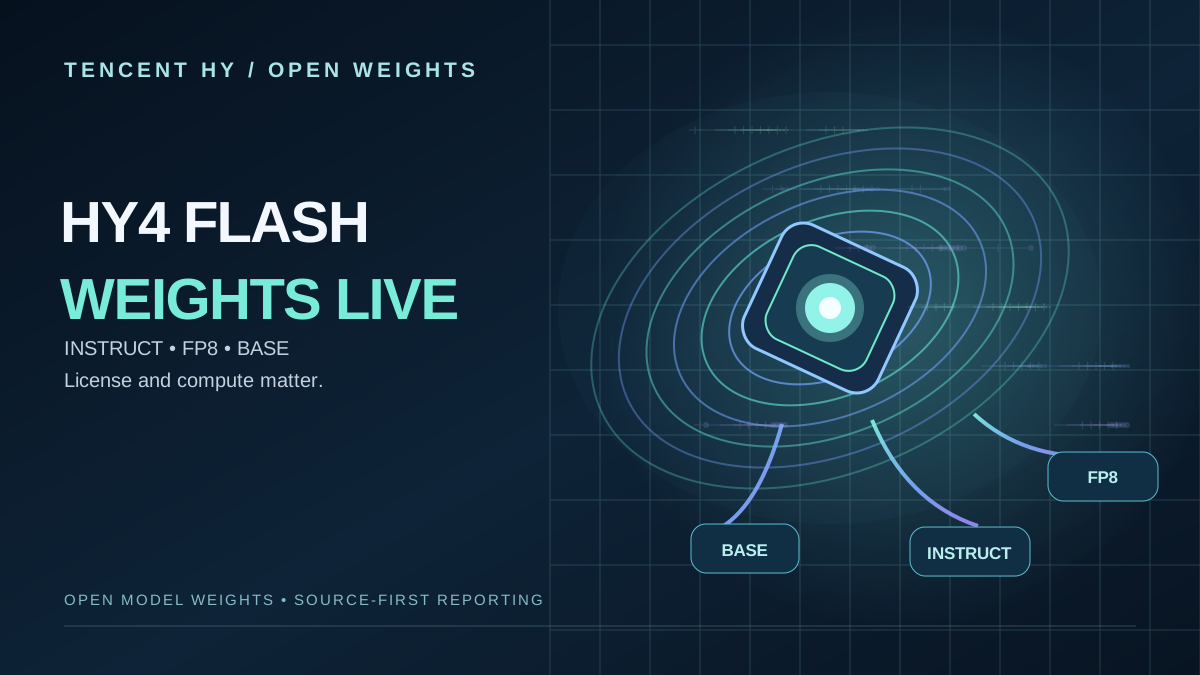
Only a day after Tencent launched Hy4 flash as a hosted service, a key part of the release story changed: its official repository now includes public model weights. The Hy team lists three separate downloads on Hugging Face, ModelScope and GitCode: the instruction-tuned Hy4 flash checkpoint, an FP8 version for lower-precision serving and a base checkpoint intended for further training. This is a substantive update to our November 17 report, which correctly recorded that usable weights had not yet been identified at the initial API announcement. Primary source ↗
Tencent describes Hy4 flash as a multimodal mixture-of-experts system with roughly 220 billion parameters in total and about 12 billion activated per token. That total includes a large Engram n-gram embedding component, so a simple total-versus-active parameter comparison does not tell an operator what memory will actually be required. The model handles text and image input and advertises a context length of up to one million tokens. It is not a small checkpoint just because its active parameter count is much lower than the full weight inventory.
The new public artifacts also clarify the engineering choices. A BF16 instruct variant, an FP8 instruct variant and a pretraining base are distinct releases: the base should not be treated as the same chat assistant, and FP8 is a quantization option rather than a new foundation architecture. Tencent publishes recipes for vLLM and SGLang, including purpose-built containers and speculative decoding using its DFly2 draft module. Its Transformers example currently points to a development pull request rather than a guaranteed stable release.
Licensing needs equal attention. The model repository declares the Tencent Hy License and includes a separate license file. That is not interchangeable with MIT or Apache-2.0; any business evaluating redistribution, hosted inference or derivative use should read the actual terms before deployment. Downloadability is a meaningful step, but does not by itself establish unrestricted open-source status.
Tencent's WorkIndex scores, cost comparisons and claimed throughput originate from the developer's own evaluation and serving configurations. Open Model Weights has not independently reproduced those results or completed a file-by-file SHA and license review for a new registry entry. The immediate editorial conclusion is narrower and more important: the previously promised checkpoint is now inspectable, with a much clearer technical and legal basis for further verification.
For builders the next step is concrete: choose the correct instruct or base variant, pin the revision, verify every required weight file, read the Tencent Hy License and select a supported deployment path. That creates a reproducible starting point for an honest comparison with other large open-weight models, without confusing API launch metrics with locally measured performance.
What this changes for the evidence layer
The prior OMW article explicitly reported weights pending at the 16 November API launch. They are now available. Before adding Hy4 flash to the verified model inventory, pin the exact current SHA for each of the three official repositories, inspect the safetensors and index manifests, review the full Tencent Hy License, and test compatibility without claiming independent benchmarks. Never relabel this license Apache-2.0.
Tencent Hy Team — official Hy4 flash model card
This brief is based on the cited primary source. Performance, benchmark and comparative claims remain attributed unless Open Model Weights publishes an independent measurement.
Open source article ↗