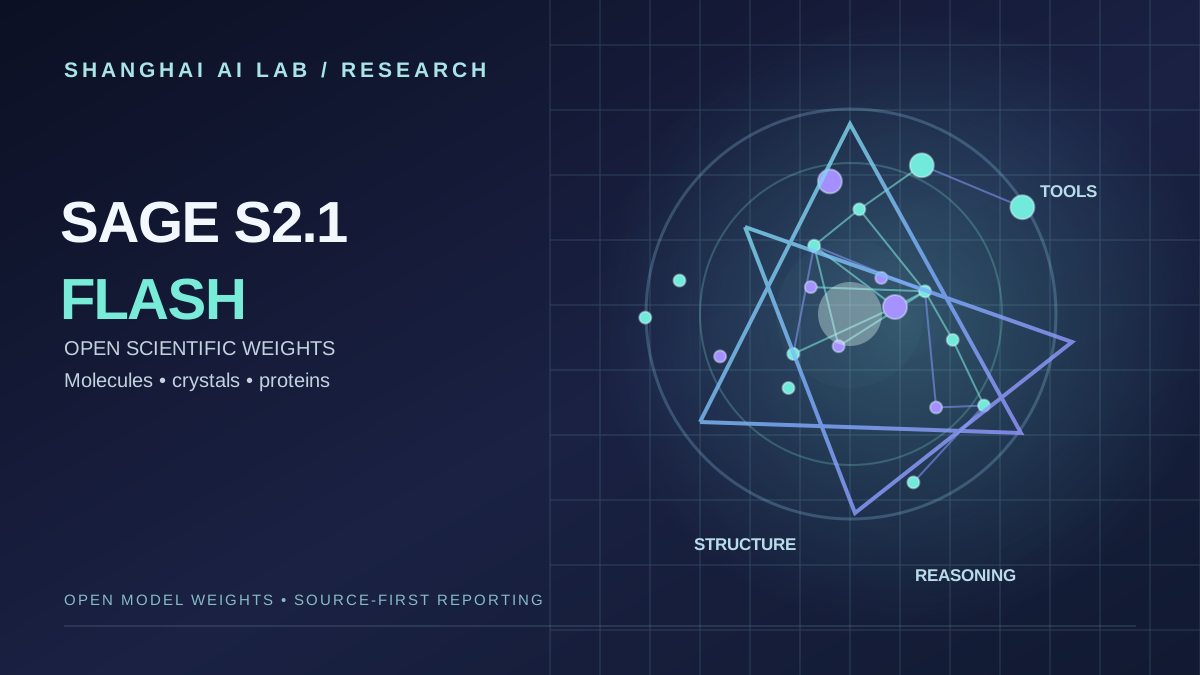
Shanghai Artificial Intelligence Laboratory has made Sage S2.1 Flash available as an openly downloadable scientific multimodal model. The official InternLM repository identifies a roughly 321-billion-parameter checkpoint and links a separate FP8 edition, both aimed at research workflows that mix natural-language reasoning with structured scientific data. The release is a fresh addition to the open-weight landscape because the emphasis is not just chat or generic code generation: the intended workflow includes scientific analysis, verification and tool-assisted iteration. Primary source ↗
The scientific pathway comes from Sage SciPerception, a complementary set of encoders and projectors. The team documents inputs such as molecular graphs, crystal structures, protein sequences and protein 3D representations. These specialized inputs are transformed into representations that can be supplied alongside text instructions. That architecture allows one agent workflow to reason over data types that a text-only general-purpose model would otherwise struggle to read faithfully.
The distinction between the main checkpoint and the supporting components matters. The model card explains that developers must download task-specific projectors and the Sage SciPerception loading scripts, configure preprocessing and scientific encoders, and use prompt embeddings when serving through vLLM. Its general deployment guidance also refers to runtime patches and configuration details. Consequently, the existence of a downloadable safetensors model is not proof that every scientific task runs out of the box in an ordinary chat application.
The team describes code and model weights as MIT-licensed in the official card. This is promising for builders, but a production adoption decision should still inspect the actual repository license and all auxiliary artifacts that the selected workflow depends on. The main checkpoint and FP8 version also require distinct revision, file and runtime verification before either becomes a fully source-pinned Open Model Weights model record.
Sage's own evaluation table reports 90.3 on MLE-bench Lite, a score ahead of DeepSeek-V4.1-Flash-1017 under the developer's stated setup. The card highlights first-place results on four of 15 featured benchmarks and runner-up results on seven more. These comparisons are useful leads, not independently audited quality rankings. They also mix general productivity, software-agent and specialized research evaluations, so no single number proves superior science.
The real significance is a practical research-agent stack: public model artifacts, specialized scientific representations and documented routes for verification through tools. For labs comparing Sage against standard language models, a meaningful test would pin the exact checkpoints, reproduce the scientific preprocessing and measure accuracy on their own validated molecular, materials or protein tasks. OMW will not mark it Leading on the strength of developer-selected charts alone.
What this changes for the evidence layer
New official Sage S2.1 Flash and separate FP8 checkpoints are candidate model entries. Pin exact model and projector revisions, inspect weight files and MIT license, confirm GLM-related runtime patches and independent dependencies, and never treat publisher benchmark tables as independent verification.
Shanghai Artificial Intelligence Laboratory / InternLM — official Sage S2.1 Flash model card
This brief is based on the cited primary source. Performance, benchmark and comparative claims remain attributed unless Open Model Weights publishes an independent measurement.
Open source article ↗