
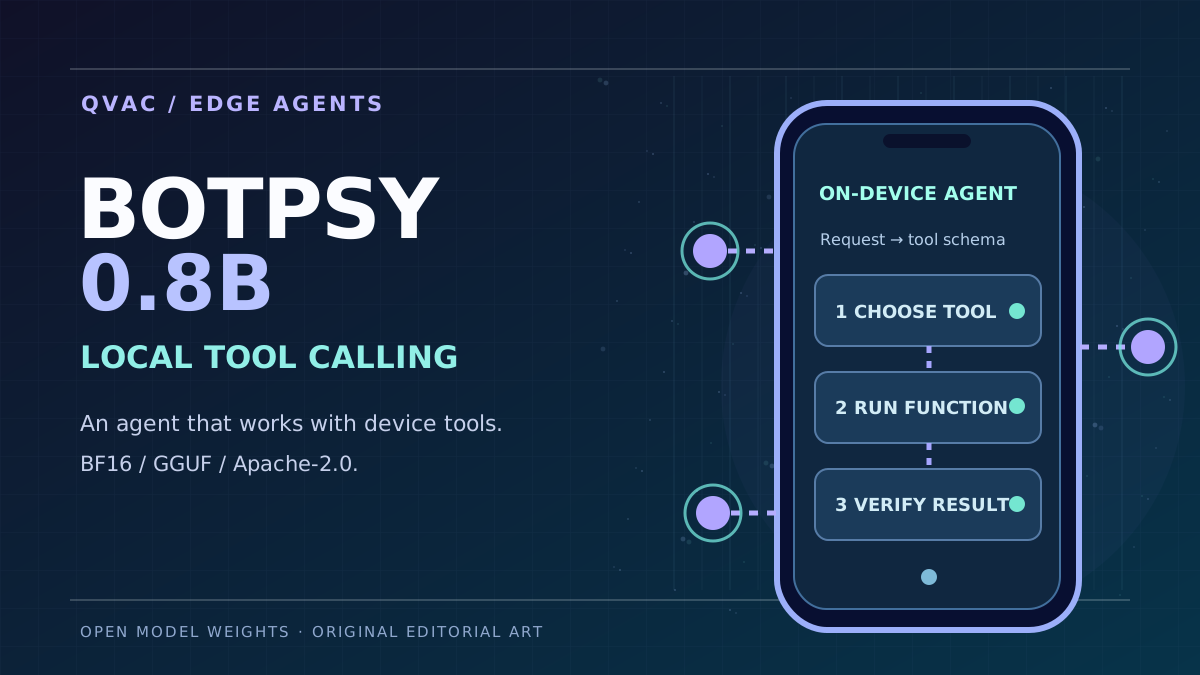
QVAC, a Tether AI Research project, has released BotPsy-0.8B as an open-weight language model specialized for local tool use. Unlike a general chat assistant, the focus is on selecting functions exposed by a host application, filling their arguments and handling the response before deciding whether another action is needed. The model is derived from Qwen3.5-0.8B and uses a four-stage post-training process involving worked examples, distillation from larger teachers and reinforcement learning. This makes BotPsy an example of specialized small-model behavior rather than a new foundation-model architecture. Primary source ↗
The November 11 release provides BF16 model weights and GGUF variants under Apache-2.0 for llama.cpp-style deployments. QVAC says the model runs on phones, laptops and desktops with conventional Hugging Face or llama.cpp inference paths. It explicitly does not release the training code and data that produced the checkpoint, so a download is not a complete research reproduction. An inference model running locally also does not guarantee that the full application stays offline: email, maps, calendar synchronization and web-search tools may connect to outside services even when model tokens never reach a hosted API.
QVAC reports BFCL v4 function-calling performance of 44.0 for BotPsy against 23.4 for its starting Qwen3.5-0.8B and 37.7 for Qwen3.5-2B. It also reports gains on ACEBench, τ-bench and ToolSandbox, including scenarios where the assistant must recover from failed operations. These are publisher-run comparisons, not independently repeated Open Model Weights measurements. More importantly, getting the right tool name on a benchmark is not equivalent to proving that a model can safely make consequential changes in a real account.
The provider's security testing illustrates that gap. It reports 31% unsafe responses when attackers place malicious instructions in content an agent reads, despite improvement over the underlying model, and explicitly warns against use for high-stakes decisions involving money, health or personal information. Production experiments should use tightly scoped tool allowlists, strict argument validation, audit logs and human approval for potentially destructive operations. Our registry would first need to verify the canonical model and GGUF repositories, SHA history, licenses and available precision formats before treating BotPsy as an independently verified model.
What this changes for the evidence layer
New candidate for source verification, not yet a registered model. Inspect qvac/BotPsy-0.8B and qvac/BotPsy-0.8B-GGUFs artifacts, revision SHA, precision variants and Apache-2.0 declarations. Distinguish issuer tool-use benchmark scores and prompt-injection rates from OMW testing.
QVAC / Tether AI Research — official BotPsy launch
This brief is based on the cited primary source. Performance, benchmark and comparative claims remain attributed unless Open Model Weights publishes an independent measurement.
Open source article ↗

