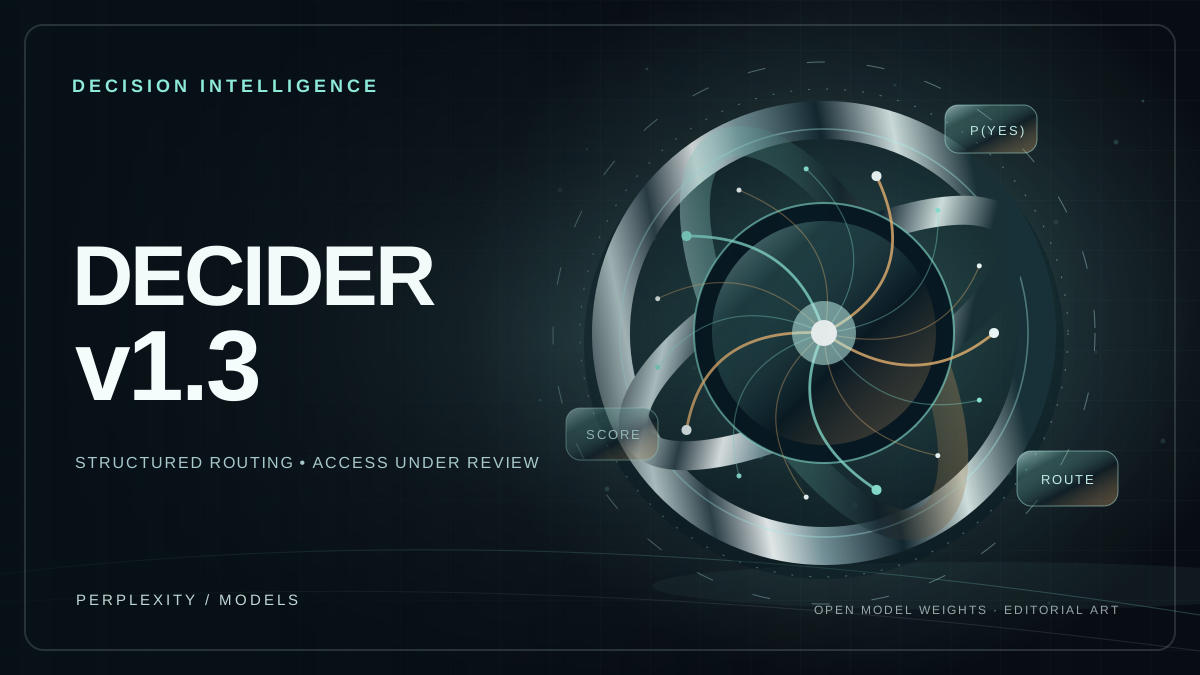
Perplexity has announced Decider v1.3 and Decider Flash v1.3, updating its specialised family of decision models rather than releasing another general-purpose conversational assistant. The official November 12 write-up describes models designed to answer structured questions about an input: which route to take, which label applies, or how likely a particular condition is. Instead of generating a long explanation, the interface returns probabilities or ordered decisions that applications can use directly. Flash is described as a smaller model distilled from the full version. Primary source ↗
The new release is particularly interesting for open-weight inference stacks where a compact decision layer can sit in front of a costly language model. Perplexity says bidirectional attention, revised training data and an updated training recipe improve robustness across text and vision tasks. Its model-card documentation describes choice, yes-or-no, score and Locate operations. Locate returns verbatim matching spans and character offsets rather than unconstrained text; such outputs are useful in extraction pipelines, although applications still need their own validation and threshold calibration.
Availability requires a distinction. Perplexity says that both versions are available through Hugging Face under an Apache license, as well as via OpenRouter and the Perplexity Decisions API. However, the full Decider v1.3 model card includes explicit instructions to authenticate with a token for a private repository. That wording is not proof of a freely downloadable public checkpoint. The original source establishes the announcement and intended licensing, not unrestricted access for an anonymous user; the two questions must be checked separately.
For Open Model Weights, the next evidence step is to verify public file manifests, license artifacts, exact checkpoint revisions and hardware requirements before any model is classed as openly downloadable. The vendor's performance and throughput comparisons remain vendor-reported. This matters because an open model entry should reflect weights people can actually fetch and reproduce, not only a permissive label in a release post.
What this changes for the evidence layer
This is a watch item, not an automatically accepted new open-weight registry entry. Verify that an unauthenticated public checkpoint, complete weight files and license text can actually be downloaded. The source's Apache claim alone cannot override private repository access, and performance tables need independent replication.
Perplexity — official Decider v1.3 release and model card
This brief is based on the cited primary source. Performance, benchmark and comparative claims remain attributed unless Open Model Weights publishes an independent measurement.
Open source article ↗