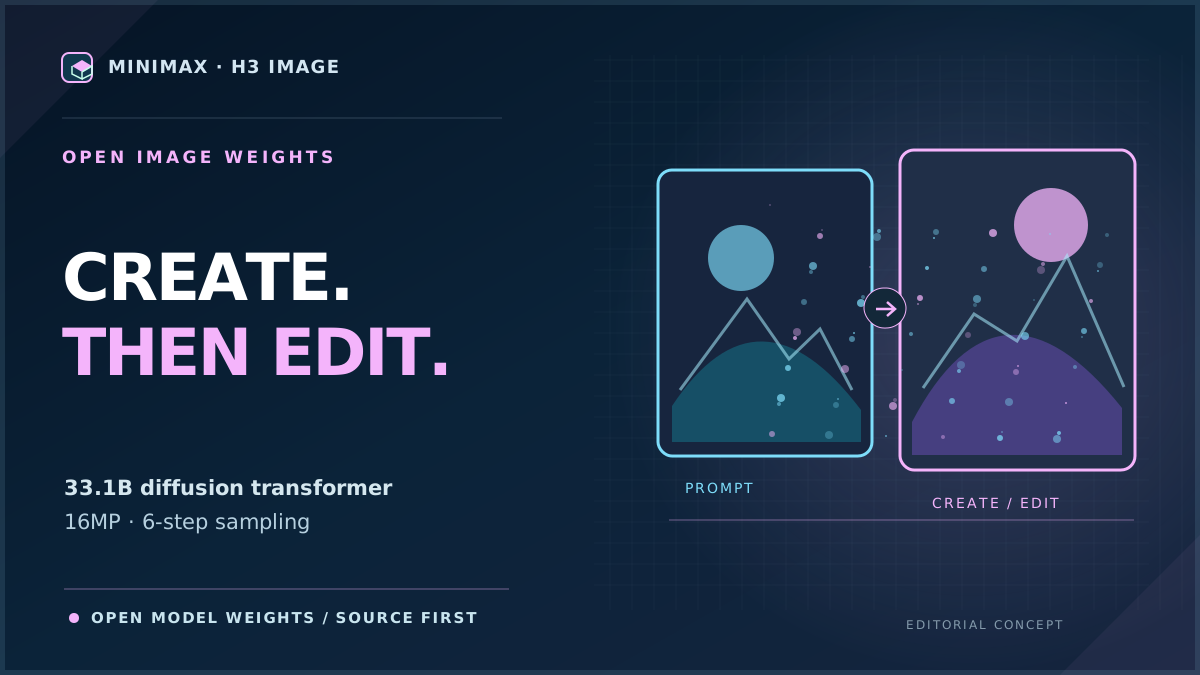
MiniMax has opened H3-Image model artifacts for text-to-image synthesis and reference-image editing through one released diffusion checkpoint. The model card describes direct output around 16 megapixels, including 4096-by-4096 square images, and a distilled generation schedule requiring six denoising evaluations. That is an interesting combination for image workflows: image creation and revisions can share a model rather than switching to a separate inpainting engine. The company's reported quality and instruction-following advantages remain vendor claims. Primary source ↗
The technical foundation is a dense 33.1-billion-parameter diffusion transformer that reuses the H3 family's text-encoding pathway. Reference images are encoded alongside prompts and assembled into a shared token sequence, while a VAE decodes predicted image latents. MiniMax says up to 16 reference images can be provided. It publishes examples for Diffusers, ComfyUI, SGLang and vLLM-Omni, giving developers multiple routes to test the checkpoint with actual prompts, source images and seed controls.
Open weights should not be confused with an inexpensive laptop deployment. The official download table lists approximately 66.28 GB for the image diffusion transformer and 2.34 GB for the VAE. A fresh installation also needs the MiniMax-H3 text encoder from a separate repository, listed at approximately 66.7 GB; optional prompt-expansion weights create another component. Practical memory requirements depend on load precision, parallelism, runtime and offloading, and cannot be read directly from file sizes. Teams should benchmark peak VRAM, latency and editing consistency under their actual serving setup.
Licensing is the second major qualification. The publisher uses a MiniMax-H3-Image Community License Agreement, not a generic Apache license, and explicitly references separate written authorization under Section IV. Commercial adopters must examine the full conditions rather than infer unrestricted downstream use from the presence of a download button. For editors and researchers, the best immediate comparison is reproducible instruction adherence, edit preservation, reference fidelity and deployment cost at matched image sizes and hardware. No such independent Open Model Weights evaluation is claimed here.
What this changes for the evidence layer
Open-weight image-model candidate; do not infer open-source or unrestricted commercial use. Admission needs SHA-pinned DiT/VAE and shared text-encoder dependencies, license-file inspection, publicly available Safetensors verification and hardware-independent metadata.
MiniMax — November 11 official H3-Image launch
This brief is based on the cited primary source. Performance, benchmark and comparative claims remain attributed unless Open Model Weights publishes an independent measurement.
Open source article ↗