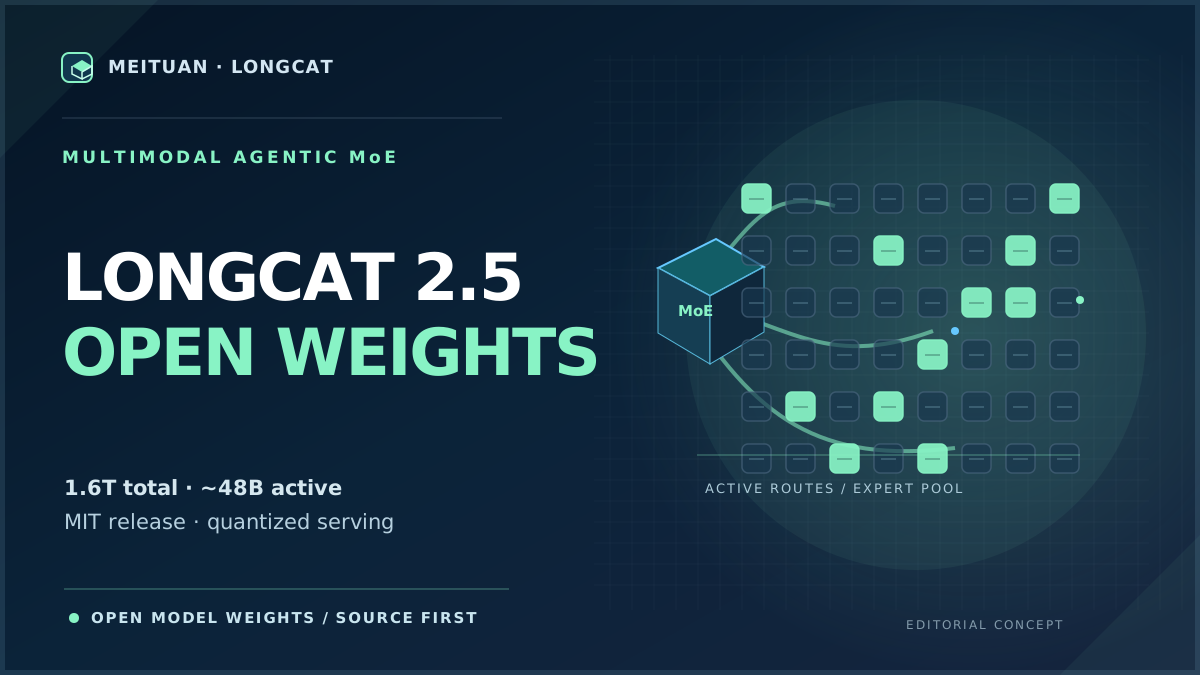
Meituan has made LongCat-2.5 model artifacts publicly available on Hugging Face under an MIT license, turning a previously discussed frontier-scale multimodal system into a release that independent teams can inspect. The model card describes a mixture-of-experts architecture with approximately 1.6 trillion total parameters and about 48 billion active for each token. Those numbers describe different things: the large pool of expert weights affects storage and deployment, while the active set indicates how much of the network is used per token. They are not evidence that this model is cheap to run. Primary source ↗
The upgrade is aimed at long-horizon agentic work, including coding across repositories, project assembly and visually grounded tasks. According to Meituan, native image features are aligned with text, while multi-teacher distillation and reinforcement learning incorporate engineering failures and multi-step interaction. The published benchmark table includes coding, general-agent and vision tasks. Some competitor scores are borrowed from other published reports, and Meituan's own measurements are not automatically comparable with independent runs. We therefore treat advertised performance as publisher evidence, not a verified ranking.
A more consequential technical detail is the documented W4A4 route for certain NPU platforms. The card describes quantized expert weights and activations, fused kernels, cache strategies and a comparison against a W8A8 MoE baseline. Reported throughput gains depend on the selected hardware, workloads, precision and serving setup. A deployment team must validate output quality after quantization and confirm that the required NPU stack, including SGLang-FluentLLM components, works with its environment. Hugging Face's aggregate parameter display may not match Meituan's architecture-specific count, another reason to preserve original technical definitions.
The repository explicitly lists MIT model licensing and a LICENSE file, a significant change for redistribution and experiment design. It does not grant trademark or patent rights. The practical assessment for buyers and researchers is therefore two-track: first verify exact revisions, shards, dependency and license files; then reproduce latency, memory demand, task completion and failure modes on a fixed workload. LongCat-2.5 is a noteworthy opening of large multimodal weights, not proof of cost-effective local deployment or universally superior coding agents.
What this changes for the evidence layer
New LongCat-2.5 source candidate for our model registry. A news article is not an admission: independently inspect the official revision SHA, exact Safetensors shards, all license files, weights accessibility, model code and multimodal dependencies before adding or changing any verified record.
Meituan LongCat — official LongCat-2.5 model card and license
This brief is based on the cited primary source. Performance, benchmark and comparative claims remain attributed unless Open Model Weights publishes an independent measurement.
Open source article ↗