
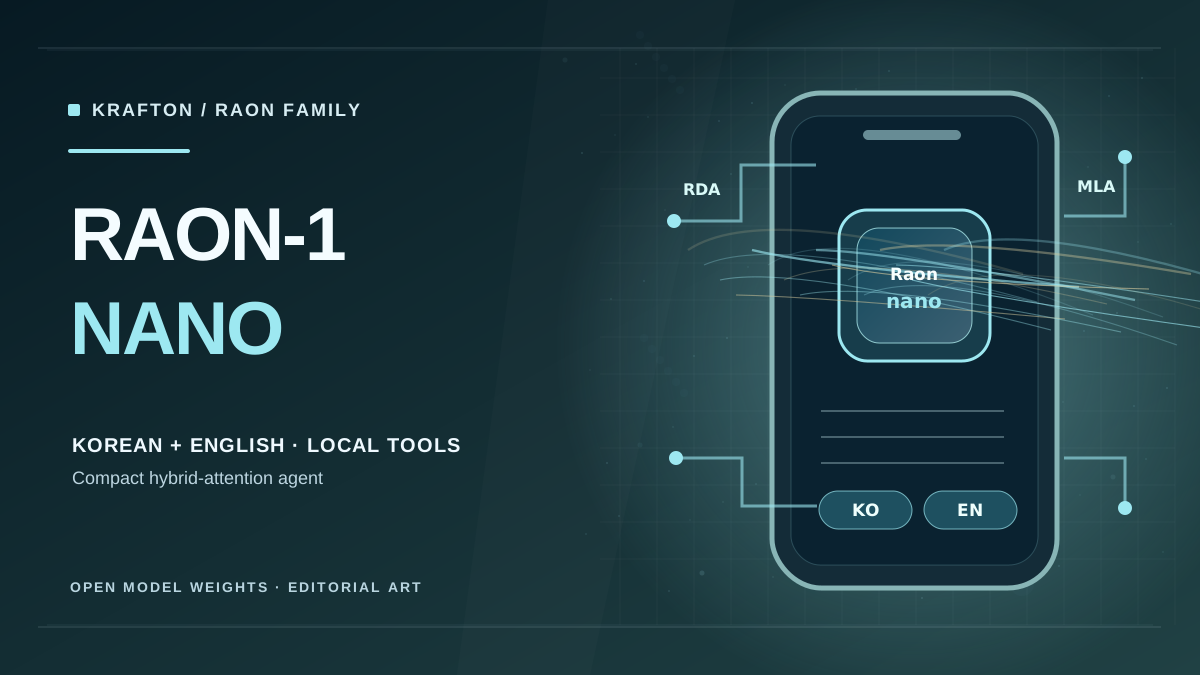
KRAFTON AI has released Raon-1 nano, an Apache-2.0 open-weight language model aimed at compact Korean-and-English assistants and local tool use. The new small-model variant follows the earlier Raon-1 mini preview but uses a different dense design rather than presenting itself as a shrunken copy with identical behavior. Its value for developers is a publicly inspectable checkpoint coupled to local-format deployment options, not an assertion that every phone can run the full advertised context window. Primary source ↗
The parameter labels need precise reading. KRAFTON describes approximately 3.1 billion total parameters for the main model, including a per-layer embedding table, but about 1.5 billion effective parameters in its architecture accounting. The model card additionally notes a 55-million-parameter multi-token-prediction module in the checkpoint. Across 24 layers, 18 use Raon Delta Attention with recurrent state and six use full Gated MLA attention. The publisher lists a 262,144-token context capacity; actual memory use and quality at that length remain runtime- and prompt-dependent.
The training account describes MoE-to-dense pruning and knowledge distillation from Raon-1 mini preview, continuing with three trillion pretraining tokens, supervised tuning, on-policy distillation and reinforcement learning. KRAFTON highlights Korean conversation, context following and function calling, with results on its chosen benchmark set. These comparisons are developer-run and do not independently establish broad superiority over every similarly sized model. Tool success under real permissions, multi-turn consistency and Korean-specific error cases need separate testing.
The official model page lists GGUF, MLX and LiteRT-LM formats that expand the practical options for local deployment, while its example Transformers loading path can require trust_remote_code. Integrators should inspect that code boundary and the exact revisions before deployment. KRAFTON explicitly states that the Apache-2.0 grant for released material does not automatically license its proprietary training datasets or undistributed components. Our next registry review should verify the canonical source SHA, actual weight and quantization files and any associated code terms before making a curated classification.
What this changes for the evidence layer
Potential new source-reviewed record for KRAFTON/Raon-1-nano; audit canonical SHA, Safetensors and GGUF/MLX/LiteRT-LM assets, Apache-2.0 scope, trust_remote_code implementation, 55M MTP attachment, model-family lineage and actual device requirements before any admission or Notable label.
KRAFTON AI — official Raon-1 nano model card
This brief is based on the cited primary source. Performance, benchmark and comparative claims remain attributed unless Open Model Weights publishes an independent measurement.
Open source article ↗

