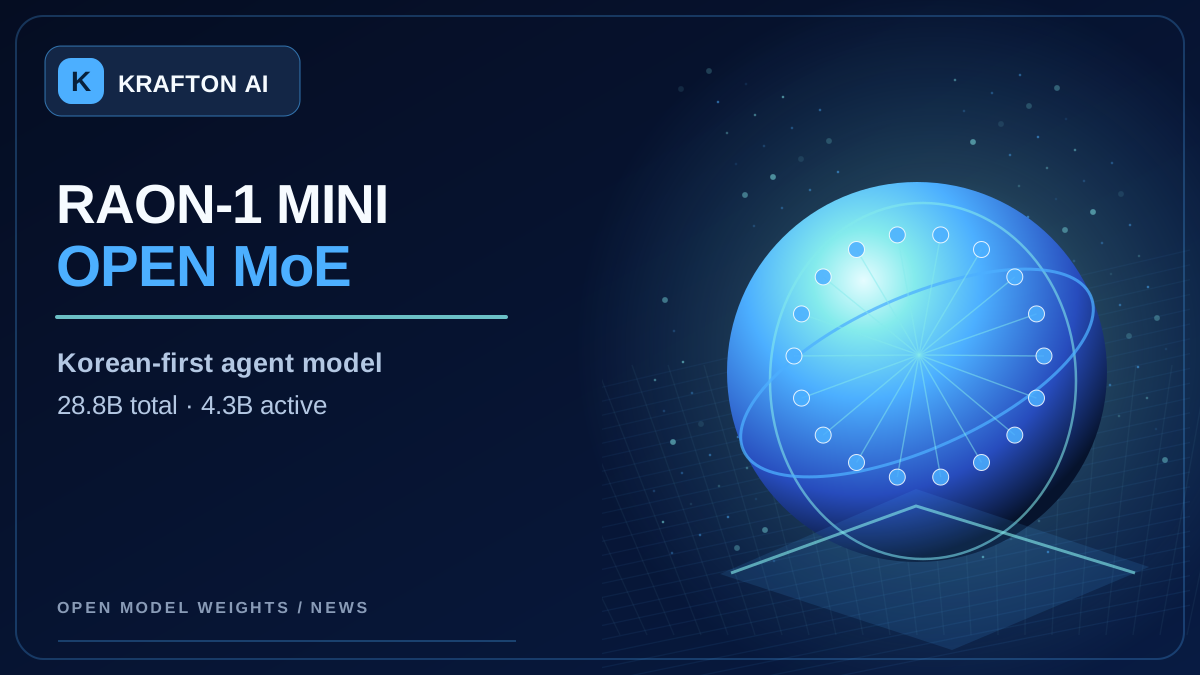
KRAFTON AI has entered the open-weight language-model race with Raon-1 mini preview, a sparse conversational and agent-oriented model trained from scratch. The official repository gives a more concrete picture than its 30B-A4B label: the architecture description lists 28.8 billion total parameters and roughly 4.3 billion activated per token. The release is relevant beyond a single Korean-language benchmark because it makes a new model family, its configuration and inference-focused derivatives available for technical inspection. KRAFTON explicitly calls this a preview; users should not treat every current specification as a final-product commitment.
Raon combines 18 Raon Delta Attention layers with seven gated multi-head latent-attention layers. KRAFTON states a native 262,144-token context window and describes a 128-expert routing design, with a subset activated for each token. The hybrid layout is intended to reduce the growing KV-cache burden of long sessions. It also supports multilingual interactions and agent tool calling, with Korean conversations one focus. These are documented capabilities and design goals, not evidence that Open Model Weights has independently tested long-context accuracy or agent success.
The release includes multiple inference options. KRAFTON publishes quantized distributions, a GGUF conversion and a DFlash2 draft-model path for speculative decoding. Its card reports throughput gains in a specifically described GPU setup; those numbers should not be copied into a general local-speed promise. Even the claimed single-RTX-5090 NVFP4 route requires checking precision, available VRAM, runtime versions and the model's actual behavior on the target machine. Use a pinned model revision, record quantization format and report decoding and prefill performance separately.
The official weights and associated model components are declared Apache-2.0 licensed, but KRAFTON notes that its hosted playground and API have their own terms. A useful evaluation compares Korean and English prompts, tool-schema reliability, context retention and recovery from tool errors against local baselines. Keep publisher benchmark tables attributed, especially where evaluation relies on a model judge or private Korean conversation sets. This is a noteworthy new open-weight checkpoint, not an independently established leaderboard winner.
What this changes for the evidence layer
Raon-1 mini is a News release, not a new OMW canonical registry entry. Any later intake must verify the precise repository revision, gated access behavior, weight artifacts, actual license file and evaluation scope.
KRAFTON AI official Raon-1 mini preview model card
This brief is based on the cited primary source. Performance, benchmark and comparative claims remain attributed unless Open Model Weights publishes an independent measurement.
Open source article ↗