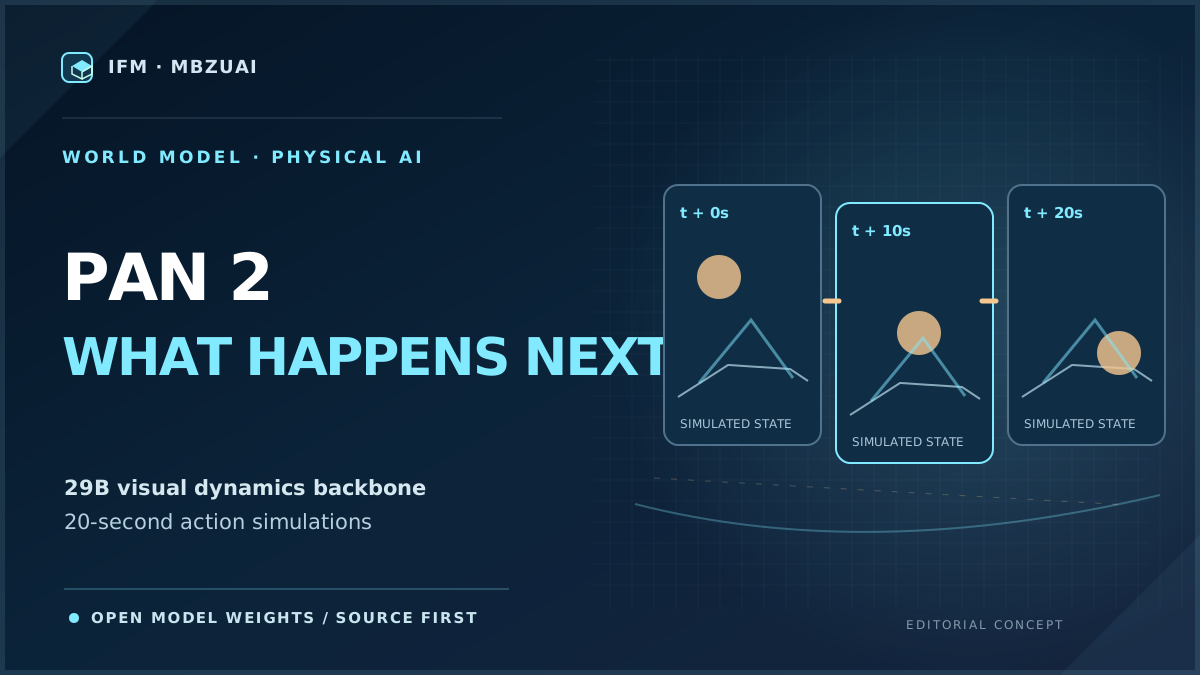
The Institute of Foundation Models at Mohamed bin Zayed University of Artificial Intelligence has introduced PAN 2, an open world model designed to estimate what happens after an action rather than merely describe an image. Give it an initial scene and a sequence of actions written in language, and the system can synthesize a video of an imagined outcome up to 20 seconds long. IFM released the video-model weights and training and inference code, making the mechanism available for scrutiny rather than showing only curated demonstrations. Primary source ↗
PAN 2 divides the problem into two roles. A conceptual reasoner, implemented with a language model, writes a structured description of events, actors, timing and camera movement. A 29-billion-parameter MMDiT diffusion backbone predicts video latents conditioned on that representation, and a Wan 2.2 VAE reconstructs visible frames. The public implementation describes Qwen3.5-9B-derived text conditioning, FSDP2 training and a precomputed-latent pipeline. This is an architecture for controlled simulation, not a sensor-verified digital twin of the physical world.
IFM says PAN 2 improves on tested baselines for planning and physical consistency and cites a public physics leaderboard. Those findings are relevant but belong to the developer's evaluation protocol. An impressive simulated plan can still miss a constraint, omit a step or produce a plausible yet physically inaccurate continuation. The team itself identifies long-term world consistency as unfinished. Before connecting such a simulator to an acting robot, researchers should specify action observability, object persistence tests, out-of-distribution scenes and the cost of planning errors.
Apache-2.0 licensing for PAN 2's own code and weights is a meaningful differentiator, while accompanying NOTICE and third-party license files still matter. The repository also illustrates the considerable infrastructure requirements of a dense 29B video system and its separate dependencies. For the Open Model Weights evidence layer, the immediate milestone is reproducible access to code, model artifacts and precise system boundaries. Future claims about useful physical intelligence must be earned by repeated, independently measured action-outcome tests, not by the mere ability to render convincing video.
What this changes for the evidence layer
PAN 2 is a fresh open-weight world-model candidate, not a validated general physical-world benchmark. Check the exact IFM/PAN2 weight revision and file access, Apache-2.0 notices, Qwen/Wan third-party licensing, memory requirements and reproducibility before any new registry entry.
Institute of Foundation Models — official PAN 2 launch
This brief is based on the cited primary source. Performance, benchmark and comparative claims remain attributed unless Open Model Weights publishes an independent measurement.
Open source article ↗