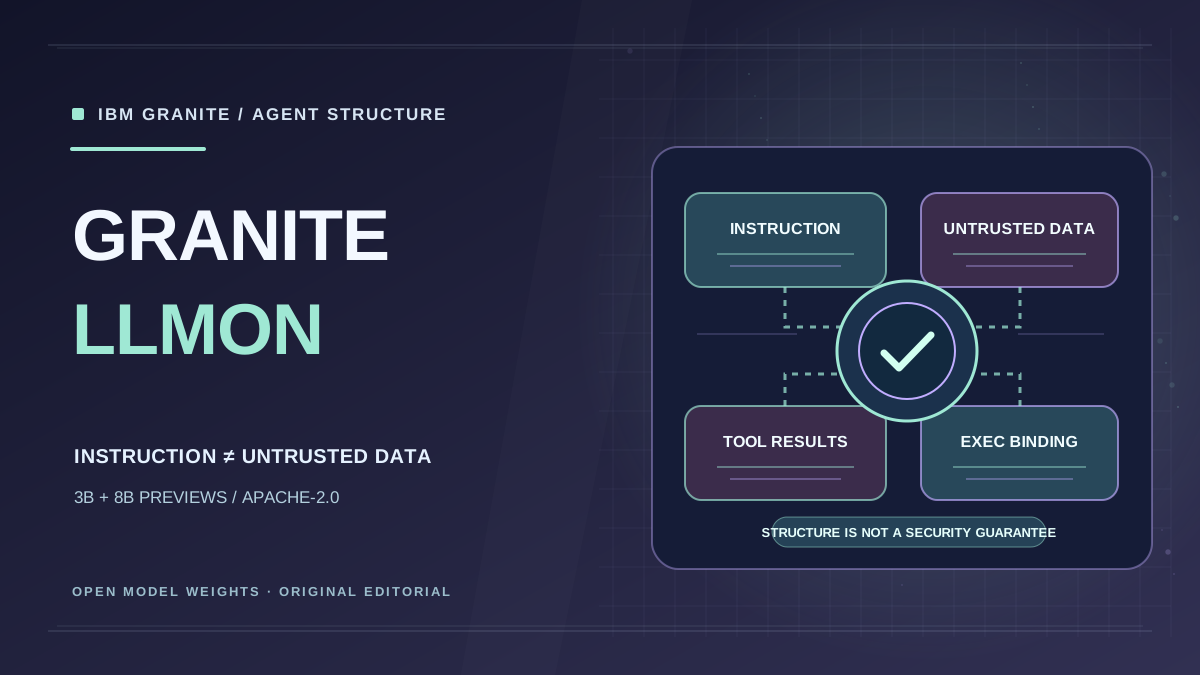
IBM's Granite team has released two experimental open-weight previews designed around a familiar failure mode in AI agents: text retrieved from a document or tool can be misread as an instruction from the user. Granite 4.1-3B-LLMON-preview and Granite 4.1-8B-LLMON-preview are downloadable Apache-2.0 models announced on November 12. They build on Granite 4.1 base checkpoints and a serialization scheme called LLM Object Notation, or LLMON. The practical significance is that IBM is shipping specialized weights as well as markup tooling, so developers can test the idea in actual inference pipelines rather than treating a prompt pattern as a standalone security claim. Primary source ↗
LLMON explicitly identifies the purpose of each prompt element. Instructions, retrieved documents, user data, requirements and tool results become tagged blocks with unique references. An execution block connects an authorized instruction to the specific data it should operate on. IBM adds six reserved delimiter tokens to support this structure. The model's shipped chat template can build LLMON from conventional message objects, while optional converters preserve fields from nested JSON. This differs from simply wrapping untrusted content in quotation marks or relying on the model to infer that a retrieved webpage is not a system command.
IBM says the previews resist many static indirect prompt injections on OPI and show similar benefits on ASB and StruQ, while maintaining broadly comparable general capabilities to Granite 4.1 instruction-tuned baselines. These results are developer-reported and benchmark-specific. IBM explicitly calls the privilege boundary a learned behavior, not an enforced guarantee, and notes that adaptive multi-turn attacks remain active research. It would therefore be incorrect to advertise the model as prompt-injection-proof or to replace tool permissions and access controls with formatted text alone.
The release matters for retrieval-augmented generation and tool-using systems because it makes instruction provenance testable at the model interface. Before production use, teams should compare their own hostile documents, malicious tool outputs, multi-turn tasks, refusal behavior and instruction-binding errors under matched prompts. IBM calls both checkpoints experimental previews and offers a public LLMON toolkit. The evidence registry should track each 3B and 8B checkpoint separately, pin its revision and Apache license, and distinguish IBM's security evaluations from independently demonstrated safeguards.
What this changes for the evidence layer
Separate checks for ibm-granite/granite-4.1-3b-llmon-preview and ibm-granite/granite-4.1-8b-llmon-preview; verify artifact SHAs, Apache-2.0 notices, special-token/chat-template compatibility and GitHub toolkit provenance. Mark experimental and treat static injection resistance as publisher-reported, not a security guarantee.
IBM Granite team — official LLMON release and model cards
This brief is based on the cited primary source. Performance, benchmark and comparative claims remain attributed unless Open Model Weights publishes an independent measurement.
Open source article ↗