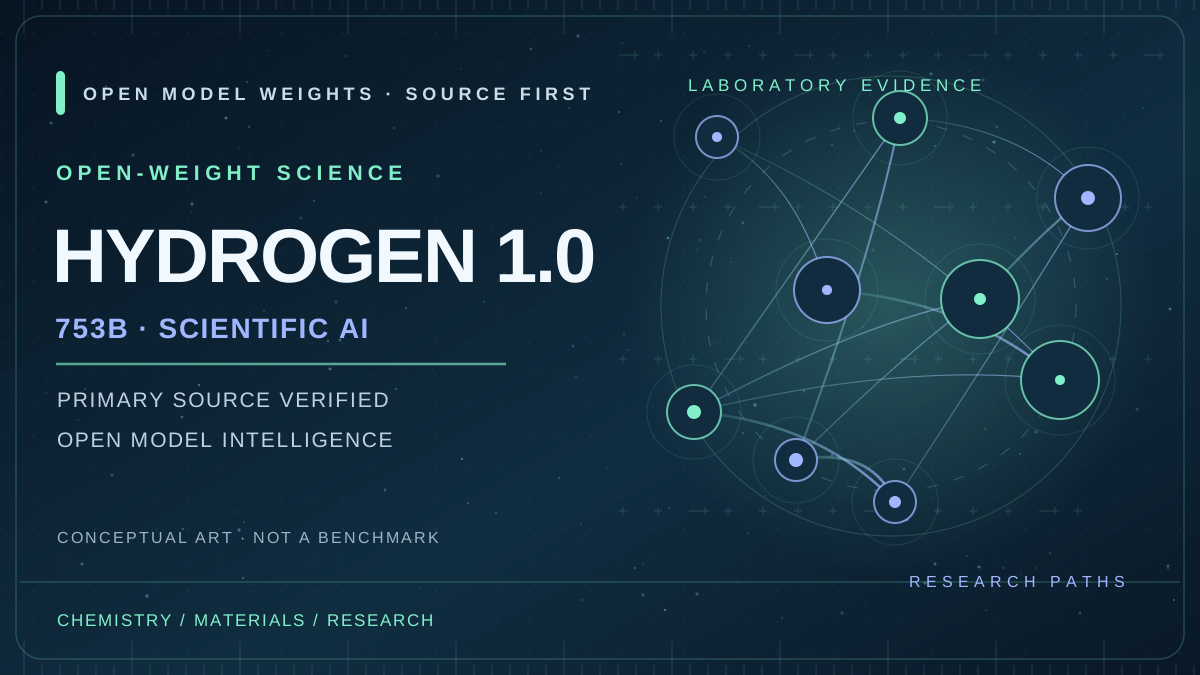
Deep Principle has introduced Hydrogen-1.0, a scientific-assistance model built by post-training Z.ai's GLM-5.3 on specialist material from chemistry, materials science and life sciences. The company also describes using laboratory records and trajectories of research decisions, including what happened when experiments or initial hypotheses changed. For open-weight science, the important development is that model artifacts are offered for download rather than access being limited to a demonstration or proprietary service. The release does not, however, make the complete underlying training datasets or recipes public. Primary source ↗
The official Hugging Face repository lists roughly 753 billion parameters, BF16 Safetensors, a one-million-token stated context limit and an MIT license for the model weights. Its page is public but downloading files requires accepting access conditions. That distinction is consequential for redistribution, reproducibility and automated research infrastructure. The publisher offers separate NVFP4 and MXFP4 artifacts intended for NVIDIA Blackwell and AMD Instinct accelerators, alongside a documented eight-GPU SGLang deployment. A maximum advertised context length does not establish the reliability of answers over every long input.
The launch describes potential scientific workflows involving reaction-network exploration, interpretation of NMR observations, computational research and compilation of experimental protocols into executable actions. Deep Principle reports results on scientific reasoning evaluations and examples of model-assisted materials searches. Those are the company's measurements and selected demonstrations, not independent Open Model Weights experiments. In particular, a plausible model-generated explanation or proposed laboratory procedure is not a scientific finding. It requires expert evaluation, independent calculation or actual experimental confirmation.
Researchers weighing this release should first inspect the exact repository revision, accessible weight shards, license notices and runtime instructions, then run task-specific evaluations with the intended precision and hardware. Reproducing a laboratory workflow also means checking safety constraints, tool permissions and the evidence behind each proposed step. Hydrogen-1.0 potentially expands the open-weight scientific toolkit, but training provenance, large-scale deployment cost and the transfer of benchmark results into real research remain separate open questions.
What this changes for the evidence layer
Open-weight science candidate, not automatically admitted to the 778-record verified registry. Although its card declares MIT BF16 weights, Hugging Face file access is gated; exact revision, license files and artifact availability need separate admission verification.
Deep Principle — Hydrogen-1.0 research announcement and official model card
This brief is based on the cited primary source. Performance, benchmark and comparative claims remain attributed unless Open Model Weights publishes an independent measurement.
Open source article ↗