
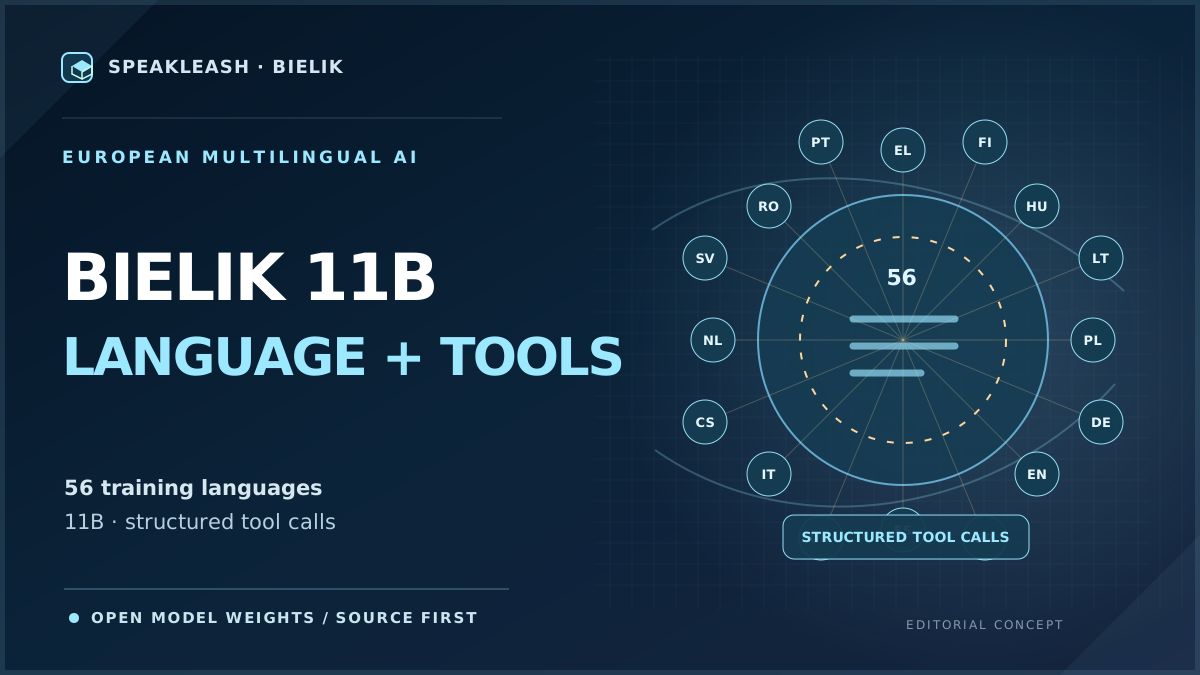
SpeakLeash and the Polish HPC center ACC Cyfronet AGH have published Bielik-11B-v3.1-Instruct, a new iteration of the 11-billion-parameter Bielik family emphasizing multilingual instruction following and agent workflows. Its official card describes training material across 56 languages, particularly Polish and other European languages. This matters for organizations that need language-localized assistants: deployment and data-governance decisions can be made around downloadable weights rather than depending entirely on a remote general-purpose provider. Primary source ↗
The training description reports 500 billion pretraining tokens, 26 million supervised fine-tuning examples and reinforcement learning in 14 environments. These are provenance statements from the team, not independently checked data audits. The card also lists an Apache-2.0 license classification. However, Hugging Face explicitly requires acceptance of access conditions before the main repository files can be retrieved, so the public page does not equal frictionless ungated downloads. Users should verify what the terms and each artifact's license actually permit.
The agent-specific point is unusually practical. Bielik v3.1 uses its own tool-call and reasoning markers, and the official vLLM instructions require a parser from the separate bielik-tools project to expose structured tool calls and reasoning fields through an OpenAI-compatible interface. Having a parser path is valuable for production integration, but it also creates version and template dependencies that generic compatibility labels can hide. A first deployment should exercise malformed arguments, repeated tool calls, tool-choice behavior, and multilingual tool descriptions before accepting it for unattended operation.
For independent evaluation, the key questions are whether Polish gains persist on real documents, how performance changes across the 56 training languages, and how much hardware is needed for the target latency. The card's multilingual language count does not establish equal proficiency in all those languages. Benchmarks should pair local-domain tasks with security and refusal tests, compare identical quantization and context settings, and document parser versions. Bielik v3.1 adds a promising European model option; its performance claims and downstream suitability remain empirical questions rather than guaranteed outcomes.
What this changes for the evidence layer
Potential multilingual/agent model intake. Distinguish the public model card from gated weight file access; validate exact official Safetensors, revision SHA, applicable Apache-2.0 notices, tokenizer, runtime parser dependencies and language evidence before registry admission.
SpeakLeash / Bielik — official November 10 launch
This brief is based on the cited primary source. Performance, benchmark and comparative claims remain attributed unless Open Model Weights publishes an independent measurement.
Open source article ↗

