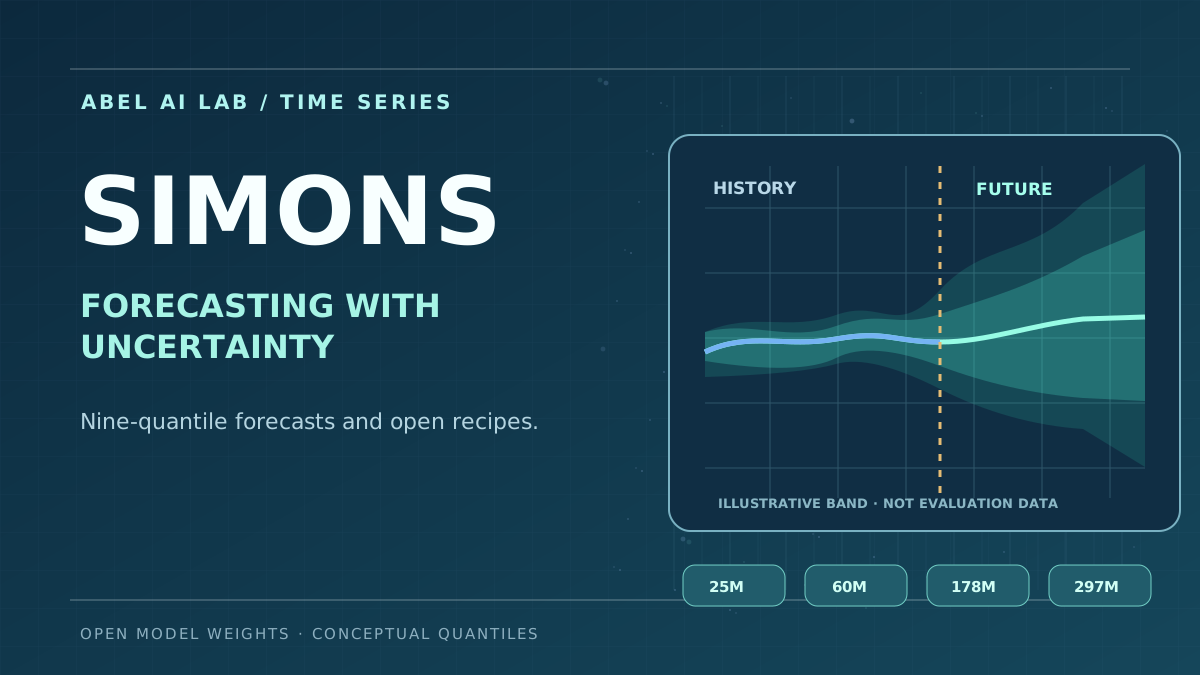
Abel AI Lab has announced Simons, a four-size family of open-weight time-series foundation models for zero-shot probabilistic forecasting. The November 11 release includes approximately 25M, 60M, 178M and 297M-parameter checkpoints, inference and training code, synthetic-data generators, public training data and reproducible recipes. Its domain is numerical sequences: predicting future load, energy demand, prices or operating measurements from past observations. The availability of training material alongside weights makes this more useful to research teams than a model checkpoint without its experimental context. Primary source ↗
Instead of emitting only a point forecast, Simons predicts nine quantiles intended to describe uncertainty across future values. It accepts univariate or multivariate histories and known-future covariates such as scheduled activity or expected weather. According to the lab's architecture description, input series are scaled and divided into 32-step patches, processed causally along time and combined through an across-variable attention stage before the forecast head. Such an approach is potentially valuable for operational decisions, but forecast intervals should still be tested for calibration and leakage on the deployment dataset.
Abel says the models emerged from an automated research process that investigated more than 250 directions and nearly 2,000 experiments at a combined GPU cost below $8,000. The lab's comparison table places Simons-297M fourth among the compared open-weight entries on GIFT-Eval, fev-bench and TIME, with higher rankings on other selected datasets. These are publisher-reported figures with different benchmark metrics and some disclosed training-data overlap; they do not justify a universal best-model label. Open Model Weights has not rerun the benchmark suites, examined cost records or checked independent reproducibility.
The legal details are not one interchangeable 'open-source' license. Abel lists Apache-2.0 for training and inference code, OpenMDW-1.1 for weights, and mixed upstream licensing for constituent data within the released collection. Teams planning commercial forecasting should inspect all three layers and the specific checkpoint's terms. They should also record exact source SHAs, context and forecasting horizons, covariate availability and chronological backtest splits. In our evidence workflow, the new release is a candidate for verification, not an automatic addition to curated Leading or Notable models.
What this changes for the evidence layer
New time-series model-family candidate. Independently check abel-lab/Simons-25M, -60M, -178M and -297M SHAs and weight files, OpenMDW-1.1 model terms, Apache-2.0 code licensing and training-data notices. No OMW independent benchmark results or curation change.
Abel AI Lab — Introducing Simons official research note
This brief is based on the cited primary source. Performance, benchmark and comparative claims remain attributed unless Open Model Weights publishes an independent measurement.
Open source article ↗